The Constraint Stack, part 4 of 8
Own the token, not the model: what Kimi K3 actually costs to serve
Cheap open models squeeze the model layer's margin, not the infrastructure's demand. Kimi K3 needs more memory and bandwidth, not less.
Published from the research archive on . Figures are as of the writing date; the update at the end is current.
Contents
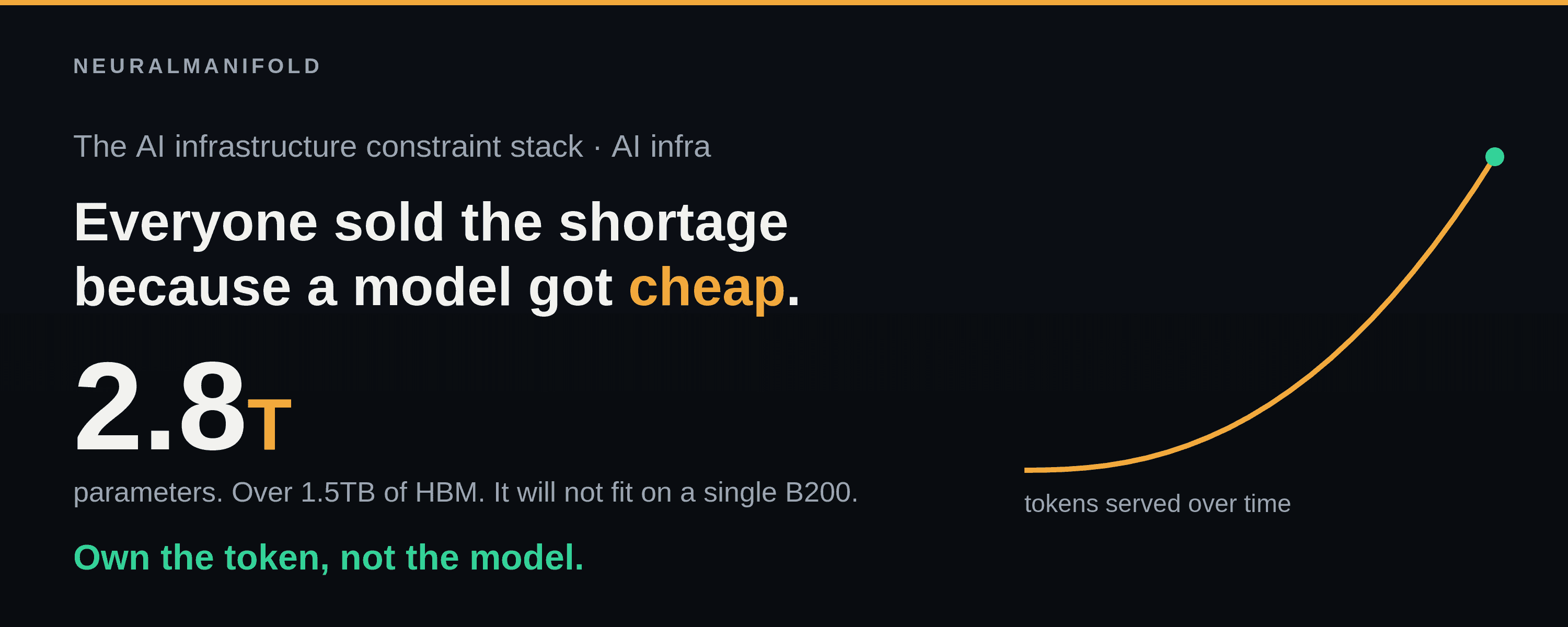
The series has tracked the AI build-out tightening one layer at a time. Memory first, then advanced packaging, then optical, then power. This week the tightening ran backward for a day. A cheaper model landed, the market read it as deflation for the layers underneath, and it sold the infrastructure. Moonshot launched Kimi K3, a model that competes with the closed frontier on coding benchmarks, with full open weights promised by July 27, and the reflex was immediate: another DeepSeek, another efficiency shock, bearish for GPUs and memory. SoftBank fell about 9 percent in Tokyo on Friday. I think the reflex is wrong, and the way it is wrong is the whole essay. Cheaper open models compress the model layer’s margin. They do not compress the infrastructure’s demand. I take that as the durable read of the constraint stack, not a hot take on one model: own the token, not the model.
Here is the claim, stated once. A model is a product that gets cheaper as open weights catch the closed labs. A token is a unit of consumption that runs on chips, memory, and networking no matter whose model produced it. When a good model gets cheap and open, more people serve more tokens, and every one of those tokens still lands on the same sold-out silicon. The efficiency shows up as margin pressure on the labs, not as demand destruction for the layer underneath. That is not a small distinction. It is the difference between a stock priced on a software cycle and one priced on a physical shortage.
Map what a K3 token actually touches
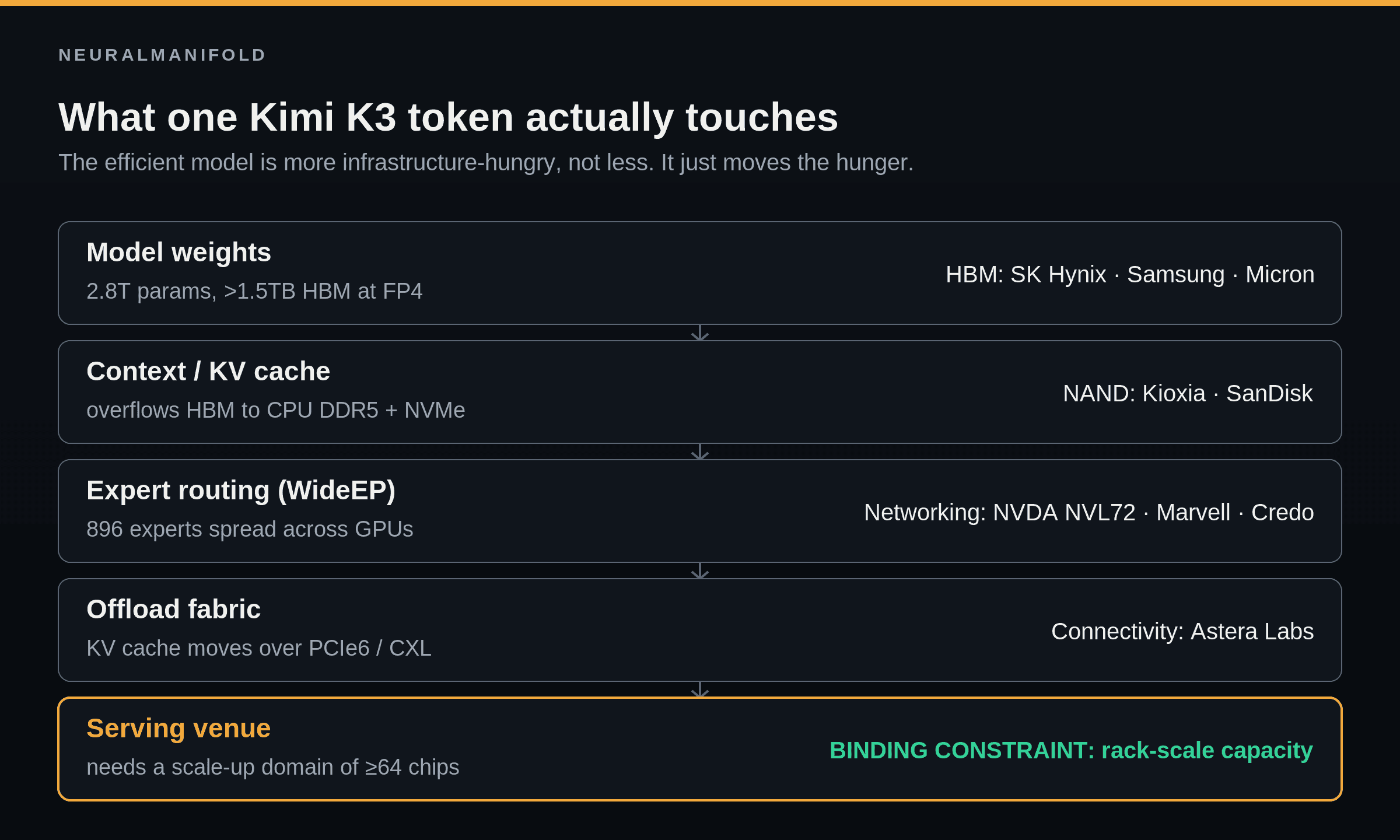
The picture that drives the deflation reflex is a model getting smaller and cheaper, so everything below it needs less. Draw what serving K3 actually requires and the picture inverts.
| Node | What K3 forces | Named public company | Binding constraint |
|---|---|---|---|
| Model weights | 2.8T parameters, over 1.5TB of memory at FP4, more than a DGX B200 holds | SK hynix, Samsung, Micron (HBM) | HBM capacity per rack |
| Context / KV cache | overflows HBM, offloads to CPU DDR5 and NVMe | Kioxia, SanDisk (NAND), the DDR5 makers | storage bandwidth and capacity |
| Expert routing (wide expert parallelism) | 896 experts spread across GPUs, heavy inter-node traffic | Nvidia NVL72, Marvell, Credo (networking) | inter-node bandwidth |
| Offload fabric | KV cache moves over PCIe Gen6 and CXL | Astera Labs (connectivity) | fabric bandwidth |
| Serving venue | Moonshot recommends 64 or more accelerators | neocloud and token-as-a-service | rack-scale capacity |
Read the map and the mechanism is clear. K3 uses a hybrid linear attention design, Kimi Delta Attention, that shrinks the KV cache, and the finance-desk reflex stopped there: less KV cache, less memory, bearish. But the model is 2.8T parameters. SemiAnalysis puts the weights alone at more than 1.5TB at FP4, which leaves almost no room for the cache, so the cache offloads to DDR5 and NVMe anyway. And the serving technique that makes the model efficient, wide expert parallelism, spreads 896 experts across many GPUs and consumes a tremendous amount of network bandwidth, which is exactly why Moonshot itself recommends deploying K3 on “supernode configurations with 64 or more accelerators.” The efficient model is more infrastructure-hungry, not less. It just moves the hunger from raw compute to memory capacity and inter-node bandwidth.
The one number that rebuts the reflex
If a single fact kills the deflation read, it is this: a 2.8T-parameter model does not fit on a single DGX B200 even at FP4. Eight B200s carry about 1.44TB of HBM between them, less than the weights alone. It needs a GB300 NVL72 or an equivalent large scale-up domain, and SemiAnalysis puts the NVL72’s scale-up bandwidth at roughly 18 times what a B200 system gets between nodes. The “cheap” model requires the most expensive, most bandwidth-dense rack Nvidia sells. That is the cleanest telemetry there is that the efficiency gain lands as demand for the scarce layer, not against it.
Put the second number next to it. SemiAnalysis argued in May that value capture has shifted from the infrastructure to the model labs, and the core of the argument is throughput: the same B300 that yields roughly 1,000 tokens per second per GPU in a baseline setup yields roughly 14,000 with a fully optimized serving stack. That 14x sits on no silicon roadmap. It is software, and it is why the labs can cut sticker prices and hold margin. But the compression runs on the same silicon that is already sold out. Micron gained about 240 percent in 2025 and SanDisk far more, because the memory vendors captured the throughput-scaling upside while the labs had no room to push back on price. The token got cheaper and the memory bill went up. That is the pattern, and K3 is the pattern’s newest instance, not its exception.
Confirmation is not opportunity
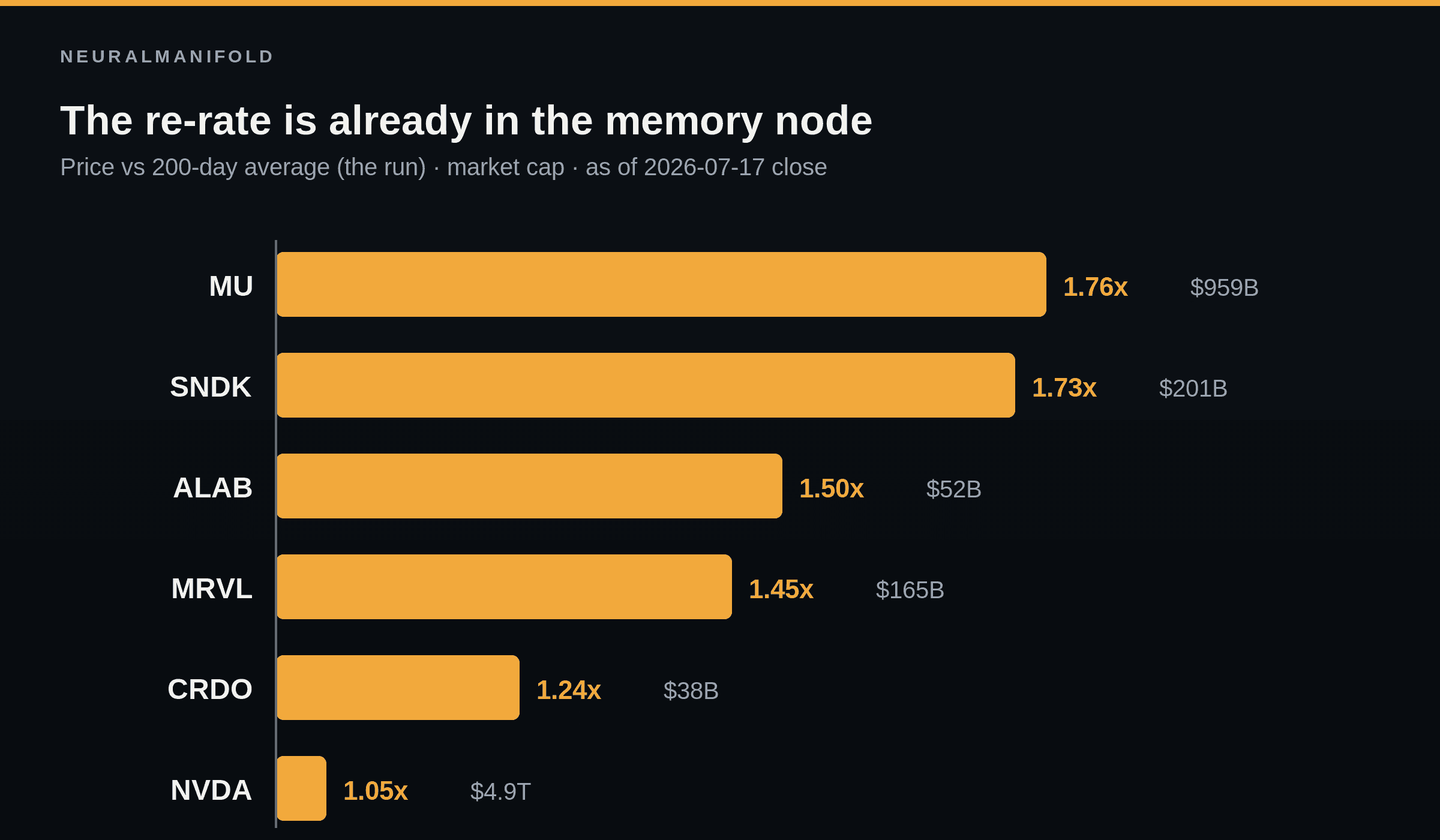
Being right that K3 is bullish for the infrastructure is not the same as being paid for it. The memory node has already re-rated, and hard. Micron closed Friday near 849 dollars for a market cap approaching 959 billion, against a 200-day average around 483 and a 52-week low of 103. SanDisk closed near 1,355 for a 201 billion cap, off a 52-week low of 40. Those are not names waiting to be discovered. They are names that already priced the first leg of the shortage. Nvidia sits at 4.9 trillion. The networking expressions have run too: Marvell 165 billion, Astera Labs 52 billion, Credo 38 billion.
The interesting part is the tape underneath those levels. Micron closed Friday about 30 percent below its late-June high, SanDisk about 42 percent below, and Marvell about 40 percent below its early-June high, all inside the July rotation out of semis. So the value-capture argument is being tested in real time. If the memory names were only a momentum trade, a rotation kills them. If they are a contracted-earnings trade, the rotation is noise on top of a floor. That is the tension a durable thesis needs, and it is why K3 matters more as evidence than as a catalyst.
The market is handicapping the wrong binary
The binary the market ran this week was simple: does a cheap open model destroy compute demand, DeepSeek all over again? Handicap it honestly and it is not close. Efficiency drives adoption, the Jevons case, at roughly 70 percent: cheaper tokens mean more tokens, and SemiAnalysis closes its own K3 thread on exactly that, more GPUs and HBM and DRAM and networking, not less. Genuine demand compression, where the world needs less silicon because models got efficient, is maybe 15 percent. The designed-around tail, where linear attention truly and durably cuts the memory bill at scale, is the other 15 percent, and K3’s own 1.5TB weight footprint argues against it.
Follow that through and the obvious binary turns out to be the wrong one. The question was never whether the tokens get served. They get served. The real unresolved variable is where the margin on those tokens lands. K3 pushes the model layer toward commodity: open weights, only 16 of its 896 experts active per token, and an API priced at $3 per million input tokens and $15 per million output tokens, Western rates, because it sells capability rather than cheapness. Once the weights are public, the serving margin at those prices belongs to anyone with the racks. That margin used to belong to the closed labs. Now it is contestable by any token-as-a-service provider who can rent the compute. That is the binary that matters: not whether tokens grow, but whether the infrastructure that serves them stays supply-constrained through the growth. The memory answer is on record. Meritz Securities estimates that suppliers can meet only 75 to 80 percent of DRAM demand in the second half of 2026 and around 60 percent in 2027. Micron expects tight conditions to persist beyond calendar 2027, and its floor is contracted through 16 take-or-pay agreements carrying roughly $100 billion of revenue at minimum price. The tokens are a commodity. The racks that serve them are not.
One-time story, or escalator
Re-rating is not the disqualifier. The question is whether the layer keeps tightening or steps once and stalls. Split the two nodes K3 lit up.
The model-lab node is a one-time story. Each open-weight release that matches the closed frontier compresses lab pricing power a little further, and that compression does not reverse. The margin migrates out of the model and does not come back.
The memory and networking node is an escalator. Every efficiency gain lowers the cost per token, which by Jevons raises the total token count, which raises total memory and networking consumed. Content per chip climbs each generation: Epoch AI estimates HBM went from 52 percent of AI-chip component spending in early 2024 to about 63 percent by late 2025, and the next models are larger, not smaller. K3 at 2.8T is the proof. The single fact that governs the continuation is HBM demand duration. HBM demand sets the length of this boom, and if it rolls over, the escalator stops. That is the number to watch, not the headline benchmark score of the next open model.
Going a layer below
The un-obvious tell on this map is the KV cache. When a model’s weights swallow the HBM, the cache has to live somewhere, and it lands on the NAND and DDR5 underneath and travels over the connectivity fabric that moves it. That is a quieter node than HBM and less priced. Kioxia and SanDisk sit on the NAND, Astera Labs sits on the PCIe Gen6 and CXL fabric that carries the offload, and Marvell sits on the custom silicon and networking that the scale-up domain needs. All of them are names I already track, which is the honest read: this chain is well-named, not undiscovered. I am not going to manufacture an upstream winner where there is not one.
Two honest caveats on the quieter node. The NAND-for-KV-cache angle is genuinely less re-rated than HBM, but NAND is more commoditized and more cyclical than HBM, so the value-trap risk is real: cheaper and for a reason. And the model maker itself, Moonshot, is private, as are most of the token-as-a-service providers who capture the newly contestable serving margin. The most direct expression of “own the token” is not investable as a pure play. That inaccessibility is itself a signal of how the value is distributed: the serving margin is up for grabs, and the public way to own it is to own the shortage underneath it, not the model on top of it.
The finding
The finding is a reframe, not a ticker. Cheap open models are a model-layer margin event, not an infrastructure-demand event. The market keeps pricing each one as a DeepSeek moment, a shock to the silicon, and each one turns out to be the opposite: a larger model, served more widely, on the same sold-out racks. The token is the durable unit of the trade. The model is the commodity that produces it. The edge is not a new name this week, because the chain is already named. The edge is refusing the reflex that sells the shortage every time a model gets cheap.
The manifold view
Up close, K3 looks like a deflation event. A cheap model beats the expensive ones, the proxies sell, the screen turns red. Pull back and the shape curves the other way. Every efficiency gain in the model layer is a demand pull on the layer below it, and the layer below it is the one that is sold out through 2027. The model is where the price falls. The token is where the bill gets paid. The trigger to watch is not the next model score. It is HBM demand duration and the 2027 fulfillment rate, and if that holds, the token thesis holds.
Update, October 2026
The split this essay argued for, strain in the model layer and strength underneath it, is what the fundamentals have shown since. In October the Financial Times reported that OpenAI’s annualized revenue was running near $50 billion, below the roughly $70 billion some outlets had reported a month earlier, while Micron said on September 30 that it expects memory supply and demand to be much tighter in fiscal 2027 and 2028 than in 2026. The tape has not fully separated the two layers the way I argued it should: Nvidia fell about 3 percent the day the OpenAI report landed. The memory side of the argument is the part the fundamentals have confirmed most clearly; whether the market pays for that split is still open.
Get the next one by email
New essays and signals on the AI build-out and markets, sent when they publish. Free. Unsubscribe any time.
Prefer a feed? RSS.
Keep reading
Research and analysis, not investment advice. Calls are measured from the day they are published. The author may hold positions in companies discussed.