The Constraint Stack, part 5 of 8
The Layer the Incumbents Left to the Merchants
The memory makers reportedly stepped back from CXL controllers. The interface layer already belonged to the merchants, and one node never re-rated.
Published from the research archive on . Figures are as of the writing date; the update at the end is current.
Contents
Most bottlenecks in this buildout tightened because demand outran supply. Memory, advanced packaging, optical interconnect, power. Each got scarce because the buyers wanted more than the sellers could make. The interface layer that sits between the DRAM and the fabric is shaped by something else. The companies with every structural advantage to own it have left it to merchant chip designers. That is the read I want to test here. Not a demand squeeze. A vacancy, and the question of who inherits it.
Start with the report, then decide what it carries. On July 20, ZDNet Korea reported, and Wccftech among others relayed, that Samsung, SK Hynix, and Micron have pulled back from building their own CXL controllers. Micron reportedly moved first and adopted a controller from the startup Primemas. SK Hynix reportedly ended its project and moved the engineers to processing-in-memory. Samsung reportedly kept its controller for internal research only. None of the three has confirmed any of it, so I treat it as a report, not a fact. The stated logic is clean. The memory makers wanted to sell CXL modules as a finished premium product, the way HBM became one, and server customers would not pay a premium for a proprietary bundle. They want a controller they can pair with any off-the-shelf memory.
The essay does not need the report to be true, because the structure was visible before it. The memory makers have long bought this silicon from merchants: SK Hynix’s own 2024 CXL memory module used a Montage controller. If the report is right, it confirms the direction. If it is wrong, the merchants still own the layer.
Map the layer that got handed out
CXL is Compute Express Link, the interconnect that lets a server pool and expand memory across the rack instead of stranding it inside one box. The controller is the silicon that makes that memory addressable, coherent, and fast. Below is the chain, upstream input to the buyer, with the named public company at each node and where the binding constraint actually sits.
| Node | What it is | Named public companies | Constraint |
|---|---|---|---|
| Media | The DRAM itself | Micron, Samsung, SK Hynix | Tight, but separately (the memory shortage) |
| Interface and controller | RCD, companion chips, CXL and PCIe controllers, retimers | Rambus, Montage (688008-SH), Astera Labs, Marvell | Merchant-owned. Incumbents reportedly stepped further back |
| Fabric | Scale-up and scale-out switches, memory expanders | Astera Labs, Marvell, Broadcom | Newest, least consolidated |
| Buyer | The rack, the AI factory | Hyperscalers, neoclouds | Wants best-of-breed, not bundles |
The binding constraint is the second row. Not the DRAM, which is a different squeeze with a different clock. The controller and interface silicon is the layer where the incumbents had the fabs, the balance sheets, and the customer relationships, and mostly left the work to others. When the party with every structural advantage declines a layer, the layer does not disappear. It moves to whoever will build it on the buyer’s terms.
The lesson generalizes. An incumbent’s decision not to build is as tradeable as its decision to build, and it is easier to miss because nothing gets announced with a ribbon. A program quietly dies, or never starts. The value migrates.
Confirmation is not opportunity
Now the single clean number that proves the layer is real and not a slide-deck abstraction. Astera Labs reported the second quarter on August 4. Revenue of 392.4 million dollars, up 104 percent year over year and 27 percent sequentially, at a 73.7 percent non-GAAP gross margin, with third-quarter guidance of 540 to 560 million dollars, roughly 40 percent sequential growth at the midpoint. Management said PCIe 6.0 products, the Aries retimers and Scorpio fabric switches, crossed half of revenue, up from about a third the prior quarter, and that Scorpio becomes its largest product family in the third quarter, one quarter ahead of its prior expectations.
That is the telemetry. A merchant connectivity vendor growing at triple digits with margins in the low 70s is not a company scraping crumbs off the incumbents’ table. It is a company being handed the table. The margin is the tell. Hardware layers that clear 70 points of gross margin are layers where the buyer has no substitute and the seller has pricing power, which is precisely what “the incumbents left it and the hyperscalers still need it” produces.
Here is where I break from the easy version of this trade. Being right that the layer is real is not the same as being paid. Astera carries a market capitalization near 57 billion dollars. Marvell, the diversified merchant, near 190 billion. Both trade at multiples that already price a connectivity land grab. Both are also about a third off their 52-week highs in the summer semis derate, so the entry looks less punishing than it did in spring. That is a valuation reset inside a still-consensus story, not a dislocation from an unnoticed one. The market saw the merchant-connectivity thesis, priced it, and then took multiple points off in a sector selloff. Re-rating started here a year ago.
The binary is not the one everyone is watching
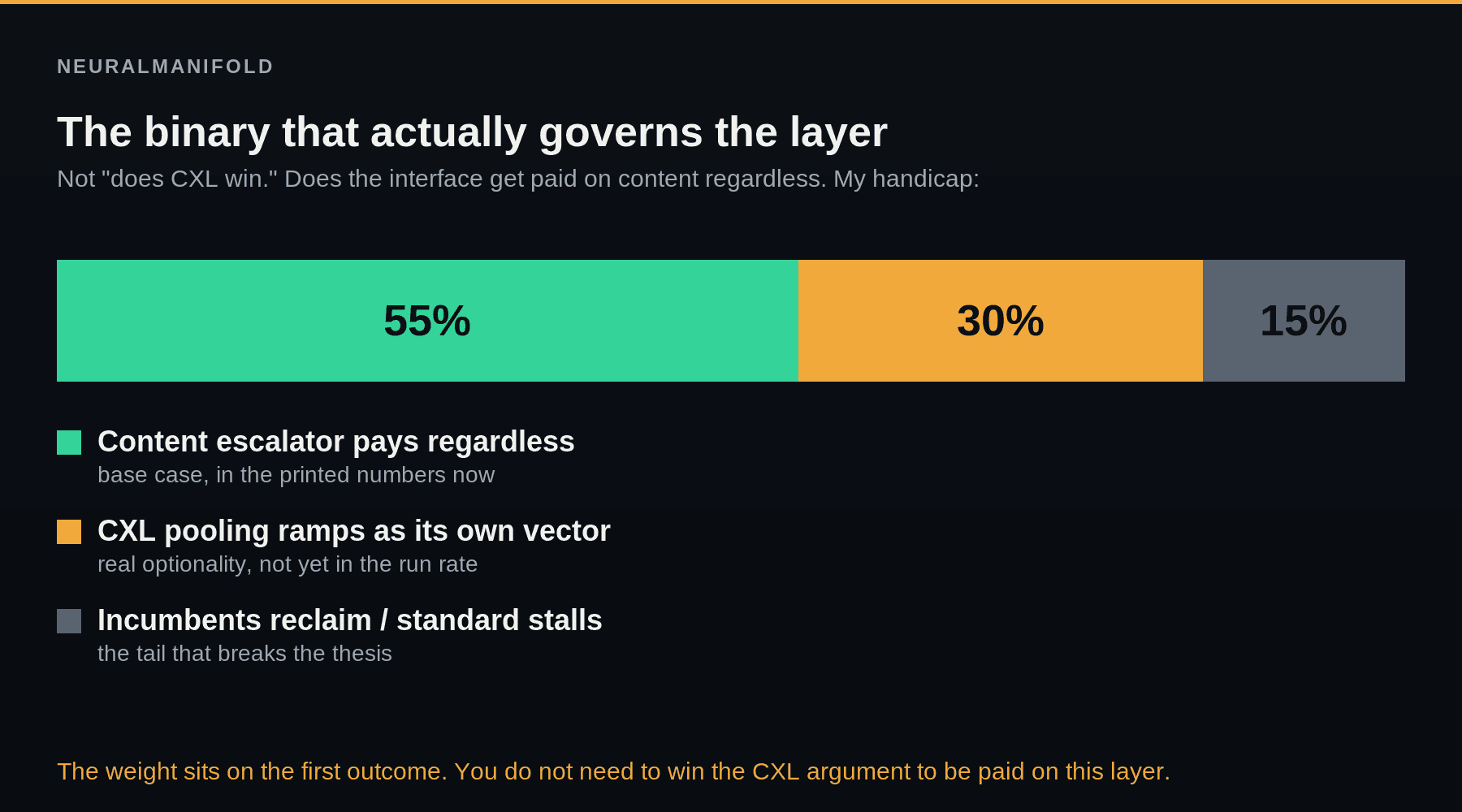
The obvious unresolved variable is adoption. Does CXL memory pooling finally ramp, after a standard that has slipped its own timelines for years? Frame the question that way and you are handicapping a coin the market has already handicapped.
Follow it one step further and the real binary is different. The merchant interface vendors do not get paid on CXL pooling. They get paid on server memory and connectivity content, today, regardless of whether pooling ever becomes the dominant architecture. Astera’s growth this quarter came from PCIe retimers and fabric switches, not from CXL memory controllers. Rambus sells DDR5 register clock drivers and companion chips into a large share of the registered DIMMs that ship, whether or not a single byte ever gets pooled. CXL is the option on top of a business that is already being paid by the content escalator underneath. So the question that governs the layer is not “does CXL win.” It is “does server memory content per rack keep climbing,” and the capex has close to answered that one.
Here is how I split the outcomes. The content escalator pays the interface layer regardless of the pooling architecture: roughly 55 percent, and it is the base case because it is happening in the printed numbers now. CXL memory pooling ramps as its own distinct, additive demand vector within a couple of years: call it 30 percent, real optionality, not yet in the run rate. The incumbents reverse course and reclaim the controller, or the standard stalls hard enough that the layer de-rates: about 15 percent, the tail that would break the thesis. The weight sits on the first outcome, which is the point. You do not need to win the argument everyone is having to be paid on this layer.
One-time step or escalator
Re-rating is not the disqualifier. The question is whether this is a one-time step or a structural escalator that keeps climbing each cycle.
It escalates, and the mechanism is content per DIMM. DDR5 registered DIMMs need a register clock driver plus companion chips. The next rung, multiplexed-rank DIMMs or MRDIMMs, doubles down: one multiplexed register clock driver and ten multiplexed data buffers per module, running at up to 12,800 megatransfers per second, more silicon content per gigabyte of memory. Then PCIe 6.0 doubles the lane rate and pulls in retimers and fabric switches. Each generation of the buildout adds interface silicon per server, not just more servers. That is an escalator, the same structural shape as the memory and packaging layers that kept running long after their first re-rate.
The name with the most escalator runway in the public set is Astera, because it sits on the two rungs that are ramping right now, PCIe 6.0 attach and scale-up fabric, and the second-quarter print shows both compounding. The single fact to watch for continuation is the PCIe 6.0 and MRDIMM attach rate, the content-per-rack line. If interface silicon per server keeps rising with each platform, the escalator holds and the merchants keep getting paid. If a future platform integrates the controller back onto the CPU or the memory die, the escalator flattens. Watch the attach, not the CXL headline.
Go a layer below, and find the node that did not re-rate
Everything above is named and largely priced. Astera is the consensus pick, Marvell is the diversified merchant, Montage is the pure-play abroad. So go one row down, into the interface silicon that the consensus connectivity screen skips, and look for the node that did not move.
Rambus is that node. By its own account it ended 2025 with a share of the DDR5 register clock driver market in the mid-40s percent, and it sells the companion set of power management ICs, temperature sensors, and SPD hubs, plus the MRCD and MDB chipsets the MRDIMM generation requires. It also licenses CXL and PCIe controller IP. So it sits directly on the escalator, it has an incumbent share position, and it carries the same CXL optionality as the merchants, one layer more upstream. And it did not re-rate with the group. Rambus closed August 7 near 101 dollars against a 52-week high of 174, about 1.5 times its 52-week low, while Astera ran 3.4 times, Marvell 3.6 times, and Micron more than 7 times off theirs. It is the one name in this chain trading below its 200-day average.
I am not going to pretend that gap is free money, because the caveats are real and they are the reason the gap exists. Close to half of Rambus revenue is still patent royalties and contract and IP licensing: in the second quarter, chip product revenue was 99.2 million dollars of 207.4 million. Royalty income does not scale with DIMM content, so the chip story is diluted in the reported line. The register clock driver market is an oligopoly it shares with Montage and Renesas, not a monopoly. And Rambus is partly a memory-cycle name, which means it is exposed to the exact bear that is driving this month’s rotation out of memory and into optical, the fear that DRAM pricing peaks within a couple of quarters. Some of the discount is that fear, correctly applied. The honest read is that Rambus is the un-re-rated interface node, and the reasons it is cheap are a revenue mix that dilutes the chip story and a memory-cycle overhang, not an absence of the link.
There is one more signal in where the cleanest expression sits. The largest pure-play memory interface vendor, Montage, is listed in Shanghai and, since February, in Hong Kong, richly valued at home, and out of reach for anyone limited to US listings. When the single best expression of a layer is the one US investors can least easily own, that access friction is itself information about how tight and how contested the layer is.
The finding
The work found a real link in an awkward place. The interface layer did not get valuable because demand overwhelmed it. It got valuable because the incumbents left it to others, and the value did not accrue to whoever eventually wins CXL. It accrued to the merchant interface vendors who get paid on DDR5 and PCIe content whether or not pooling ever becomes the architecture. The layer went to the merchants, and the merchants mostly already re-rated. The one node that did not, Rambus, is cheap for reasons that are about revenue mix and the memory cycle, not about the link being weak. That is the finding. The method is the product here, not a recommendation: when an integrated incumbent declines to build a component, follow where the layer lands, then check whether the escalator underneath it is already being paid.
Between the two US merchants, Astera is the cleaner escalator on purity and margin, while Marvell carries breadth and a custom-silicon drag. The facts that would break the Marvell read are a public re-award or in-housing of a major custom-silicon socket, or confirmation that the interface content escalator flattens as platforms integrate the controller back in.
Update, October 2026
The CXL report is still a report: none of Samsung, SK Hynix, or Micron has confirmed it, so the opening premise stays unconfirmed while the structural argument underneath it kept printing. Marvell reported fiscal second-quarter revenue up 37 percent with data center up 46 percent, and raised its outlook for fiscal 2027 and 2028. The prices went the other way on the two names this essay leaned on: from the August 7 close to October 23, Rambus fell about 16 percent to near 86 dollars and Astera about 23 percent, so the un-re-rated node got cheaper instead of catching up, and that part of the read has not worked yet.
Get the next one by email
New essays and signals on the AI build-out and markets, sent when they publish. Free. Unsubscribe any time.
Prefer a feed? RSS.
Keep reading
Research and analysis, not investment advice. Calls are measured from the day they are published. The author may hold positions in companies discussed.