The Constraint Stack, part 6 of 8
The warrant is a weapon now
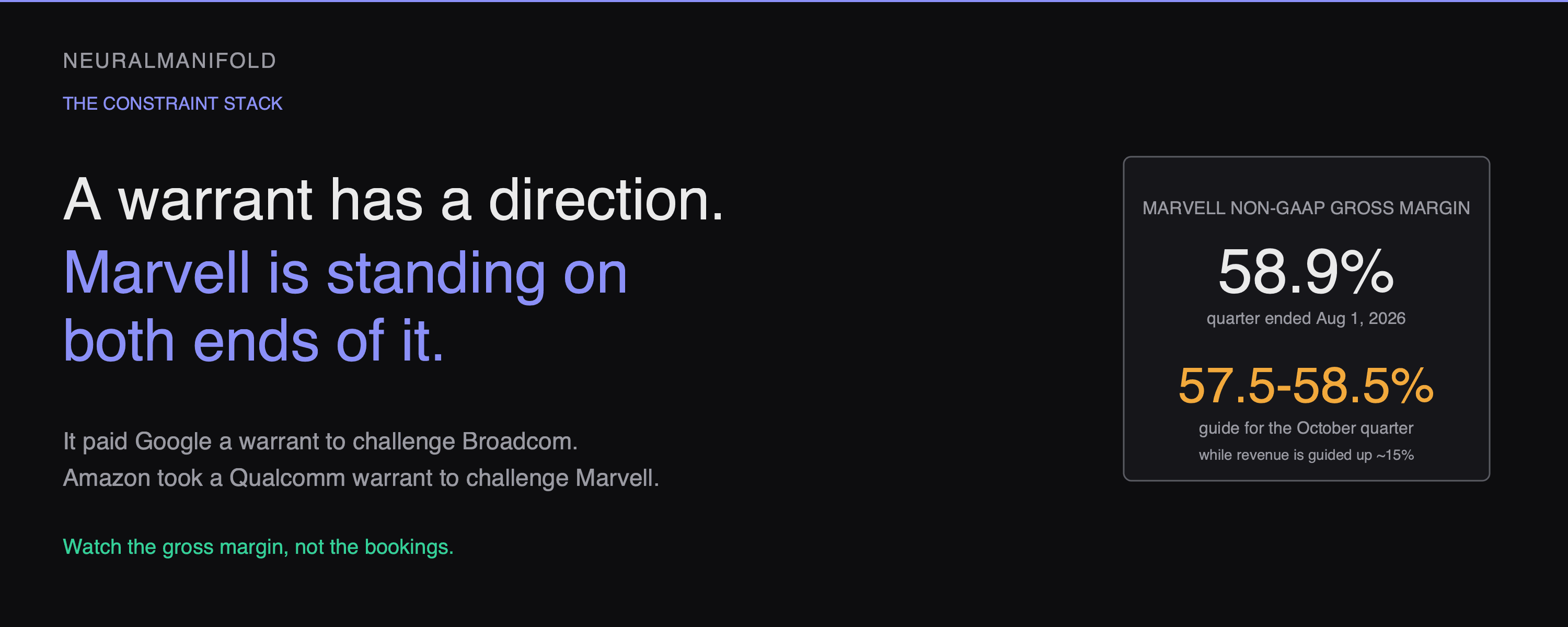
Hyperscaler warrants now fund challengers against incumbents. Marvell sits on both sides of that trade, and its gross margin is where it shows.
Published from the research archive on . Figures are as of the writing date; the update at the end is current.
Contents
The claim: buyer warrants are now a recurring way for the largest buyers to fund a second source against a vendor they already pay, and the bill lands on the incumbent’s gross margin. The warrants are confirmed in filings; the margin effect is my read. Marvell sits on both sides. It issued Google a warrant, and Amazon took one from Qualcomm in a deal that reaches into optical connectivity, where Marvell already supplies AWS. The test: Marvell’s non-GAAP gross margin floor of 57.5 percent, guided for this quarter and next, with a preliminary view that fiscal 2028 stays in range, plus a second check that separates pricing from mix.
This series has traced the AI build-out tightening layer by layer, and the customer warrant has been its cleanest supply tell. Here it turns around and points at an incumbent the build-out has rewarded.
Map the mechanism, not the chain
A few terms first. Merchant silicon is a standard chip a vendor sells to many buyers. Custom silicon is a chip designed for one buyer. A socket is one design slot in one buyer’s system. An optical DSP is the signal-processing chip inside an optical transceiver, the part that turns light into data at 800G and 1.6T.
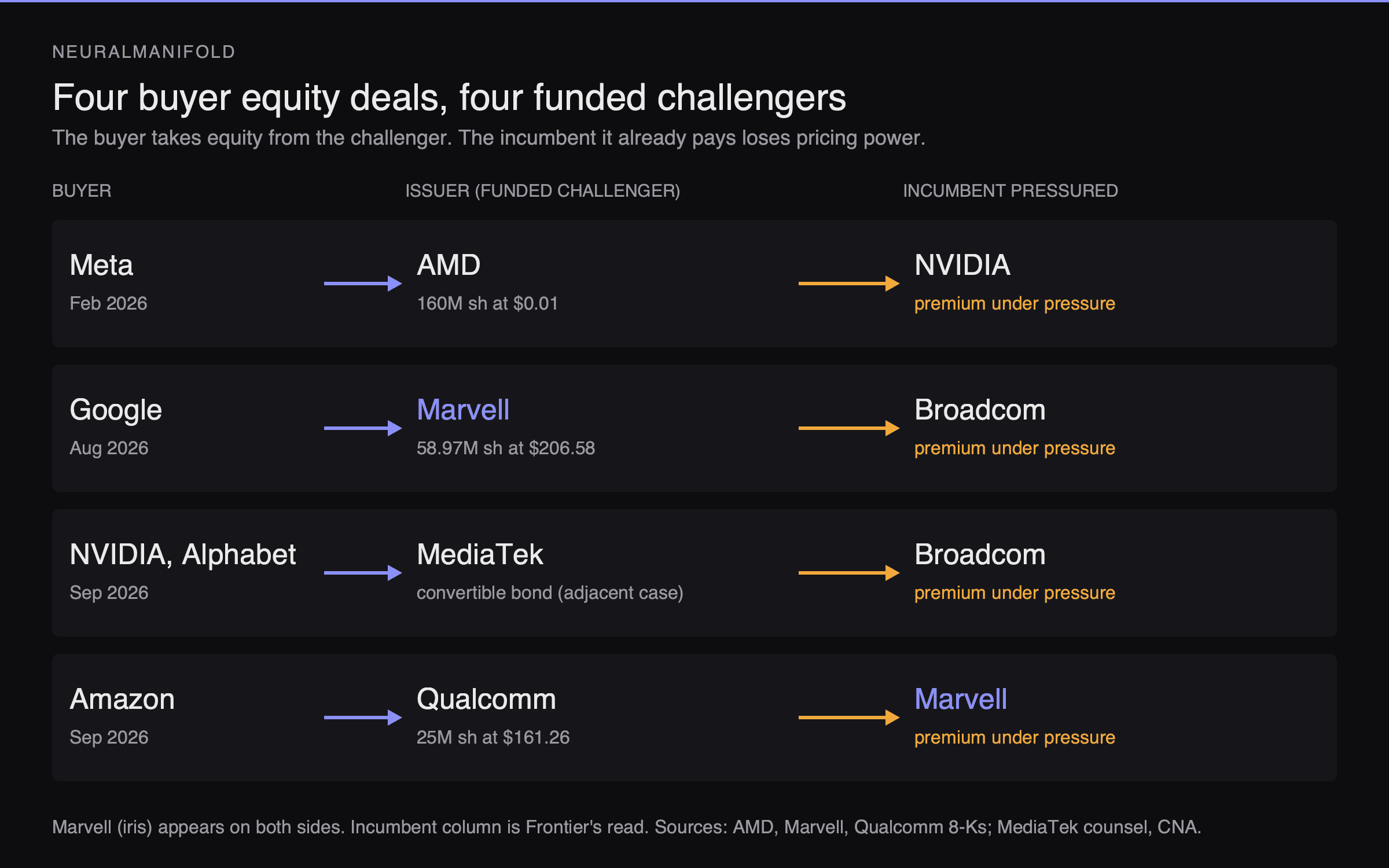
The earlier essays mapped supply chains. This one maps a triangle. A buyer takes equity from a challenger, the challenger gets a funded socket, and the incumbent the buyer already pays loses pricing power on that socket. The warrant is always issued by the challenger, so the challenger pays in equity.
| Date | Buyer | Equity issued by | Terms | Incumbent pressured (my read) |
|---|---|---|---|---|
| 2026-02-23 | Meta | AMD | warrant, up to 160M shares at $0.01, vesting on up to 6 GW of GPU purchases and AMD share-price thresholds that rise to $600 | NVIDIA |
| 2026-08-18 | Marvell | warrant, up to 58.97M shares at $206.58, one tranche per $500M of custom revenue | Broadcom | |
| 2026-09-01 | NVIDIA, with Alphabet | MediaTek | convertible bond: NVIDIA took 3.5 billion dollars of a record 3.9 billion, Alphabet also took part | Broadcom |
| 2026-09-03 | Amazon | Qualcomm | warrant, up to 25M shares at $161.26, vesting on up to 60 billion dollars of payments | Marvell at AWS |
Sources: AMD 8-K (Feb 2026); Marvell 8-K (Aug 19, 2026); Taiwan’s Central News Agency (Sep 1, 2026) and MediaTek’s counsel Sullivan and Cromwell (Sep 2, 2026); Qualcomm 8-K and release (Sep 8, 2026).
The last column is inference, so here is the basis for each. Broadcom is widely reported as Google’s custom TPU partner, and Marvell’s warrant covers “custom silicon programs that attach to the TPU ecosystem.” MediaTek’s bond is the adjacent case, a bond rather than a warrant. It came with MediaTek’s adoption of NVIDIA’s NVLink Fusion to help customers build custom AI chips, and Alphabet, Broadcom’s TPU customer, took part in it. The Qualcomm row needs the most care. Its 8-K ties vesting to purchases of Qualcomm “server chip products, technology, systems and manufacturing services,” not to optics by name. Qualcomm’s release adds that the two companies are also working on optical connectivity extending up to 1.6T. Marvell named optical DSPs as part of its five-year AWS agreement in December 2024, and its CEO calls optical DSPs one of Marvell’s “market-leading franchises.” So the AWS optical work is where Marvell is the incumbent being challenged.
Amazon runs the same play one layer over. Applied Optoelectronics issued it a warrant on up to 7.9M shares in March 2025, and Astera Labs issued it a second warrant in February 2026 tied to up to 6.5 billion dollars of switch, signal-conditioning and optical-engine purchases. Counting only 2026, that is four buyer warrants plus the MediaTek bond in seven months.
Validate it with one number
The cleanest telemetry is Marvell’s own guide. In the quarter ended August 1, Marvell reported revenue of 2.739 billion dollars, up 37 percent, data center up 46 percent, and non-GAAP gross margin of 58.9 percent. For the October quarter it guided revenue to 3.15 billion dollars at the midpoint, plus or minus 5 percent, and non-GAAP gross margin to 57.5 to 58.5 percent (Q2 FY27 release). Revenue up about 15 percent sequentially, margin down 40 to 140 basis points.
The CFO named the cause on the August 27 call: mix is “the primary driver,” with the forecasted acceleration of the custom business creating the sequential headwind. Custom work carries a lower margin than the merchant franchises, so mix alone pulls the blend down. He said the fourth quarter should stay in the same range and gave a preliminary view that fiscal 2028 would be in a “similar range, same range,” on the same call where Marvell said custom revenue will more than double in fiscal 2028. That range is the number to hold Marvell to.
One limit on the metric. Non-GAAP margin tests the target side of Marvell’s exposure, and Marvell has not said how it will book the Google warrant. Applied Optoelectronics books its Amazon warrant as a reduction of revenue, about 2.5 percent of sales to the warranted customers. If Marvell does the same, part of the warrant’s cost lands in reported margin too. I size the issuer side in the equity math below.
Confirmation is not opportunity
P/S is price-to-sales, market cap divided by the last twelve reported months of revenue.
| Name | Role | Price | Market cap | P/S (TTM) | YTD | 3-month |
|---|---|---|---|---|---|---|
| Marvell (MRVL) | target and challenger | 235.01 | ~211B | 22.3x | +176.5% | -11.9% |
| Broadcom (AVGO) | most-pressured incumbent | 364.38 | ~1.74T | 23.0x | +5.3% | -7.1% |
| Qualcomm (QCOM) | funded challenger | 176.40 | ~186B | 4.2x | +3.1% | -14.1% |
| Astera Labs (ALAB) | Amazon-warranted merchant | 300.54 | ~52B | 42.9x | +80.7% | -12.0% |
Prices are the 2026-09-09 close. The 3-month change runs from the 2026-06-09 close.
Broadcom, the incumbent pressured twice in two weeks, is down 7 percent in three months. Qualcomm trades at 4.2 times sales and moved about 3 percent on the day of the Amazon release. Marvell is the hard one to read. It is up 177 percent this year at 22 times sales, so the market still prices it mainly as a winner of the custom era. It is also down 12 percent in three months and sits about 29 percent below its 52-week high of 329.88, so some of the target side is now in the price. At 22 times sales, the margin line has to hold for the multiple to hold.
Using the filings and the 2026-09-09 close, Marvell’s Google warrant is about 1.68 billion dollars in the money if fully vested, roughly 0.8 percent of its market cap. Qualcomm’s Amazon warrant is about 0.38 billion dollars in the money, roughly 0.2 percent of its cap. The challenger pays in equity. The incumbent pays in margin. Marvell carries both.
Handicap the binary, then check it is the right one
The obvious binary is whether Qualcomm takes the AWS optical DSP socket from Marvell. In the near term, mostly no. Qualcomm’s release gives no shipping date for the optical parts, and new DSPs take long qualification cycles at a hyperscaler. I fold that risk into the smallest outcome below.
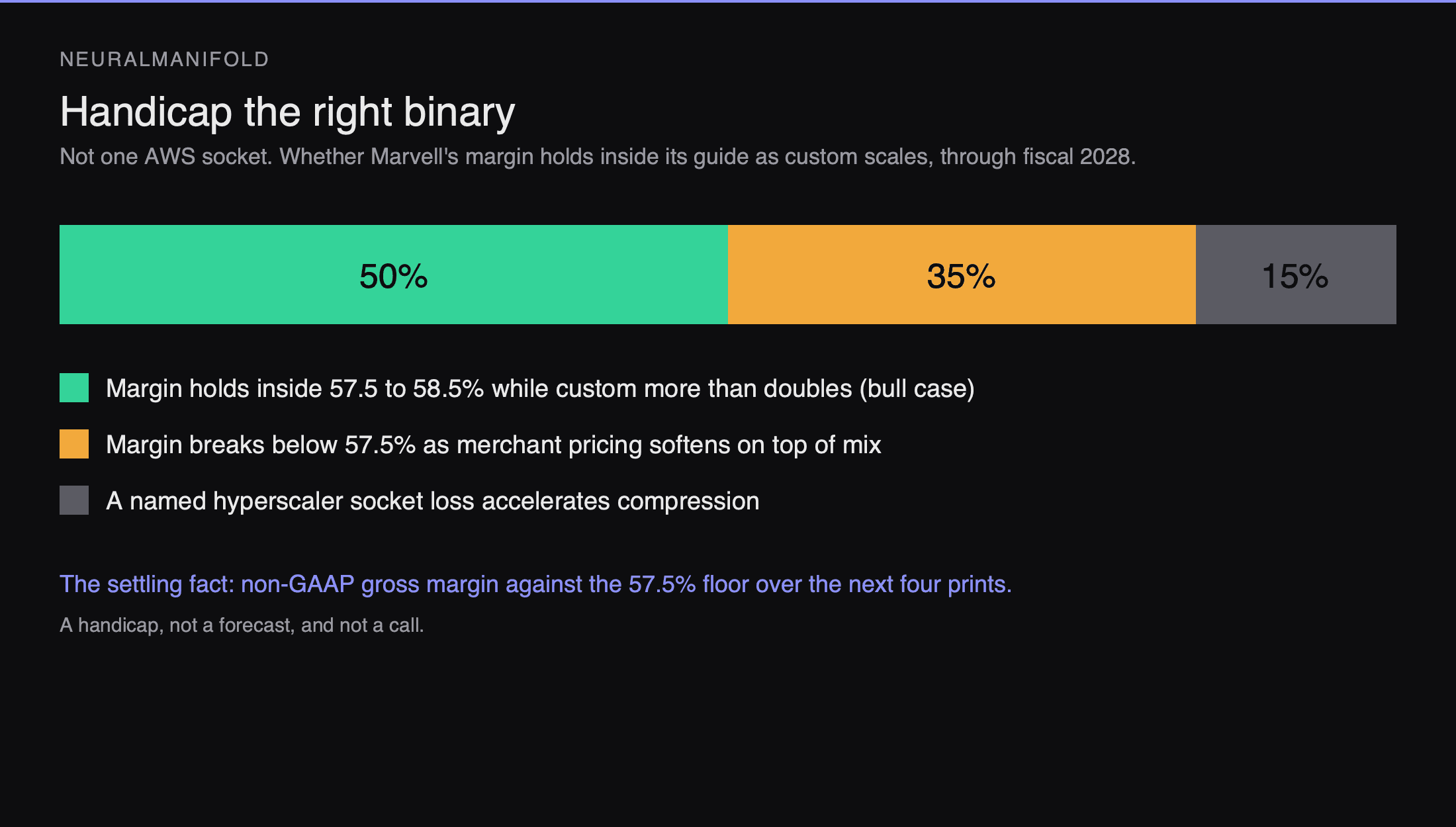
One socket does not move a 200 billion dollar company, so that is the wrong binary. The variable that decides the multiple is whether Marvell’s margin holds inside its range as the custom book scales while funded challengers come for its merchant lines. The bull case deserves its full weight. On August 27 Marvell raised its fiscal 2028 revenue outlook to about 18 billion dollars from 16.5 billion, said custom will more than double next year, and said the Google programs lift custom above its prior view of 10 billion dollars or more in fiscal 2029, with detail promised at an October 6 Investor Day. If bookings grow that fast, a point of margin is noise and the warrant to Google was money well spent.
I handicap three outcomes through fiscal 2028. Margin holds inside 57.5 to 58.5 percent while custom more than doubles: about 50 percent. I weight it highest because management has set the range for two quarters, sketched fiscal 2028 in it, and the challengers aimed directly at Marvell’s merchant lines are few: Qualcomm at AWS optics, and Astera on optical engines. Margin breaks below 57.5 percent as merchant pricing softens on top of mix: about 35 percent, because the instrument is cheap to repeat and Amazon has now used it at least three times in connectivity. A named hyperscaler socket loss speeds the break: about 15 percent, capped by long qualification cycles.
The floor alone cannot separate my story from the one Marvell already told, because margin down while custom grows is what mix predicts too. So the test has two parts. First, the mix residual. Management’s fiscal 2028 view keeps margin in range while custom more than doubles, which only works if merchant margins hold or rise. A print below 57.5 percent in a quarter where custom grew faster than the rest of the company is ambiguous, and I will treat it that way. A print below 57.5 percent in a quarter where custom did not outgrow the rest of Marvell cannot be mix. That is merchant pricing. Second, the warrant-specific tell: the first quarter Qualcomm discloses optical connectivity revenue from AWS, read against what Marvell says about its optical DSP line in the same quarter. Pricing pressure from a funded second source shows up in the merchant line first.
Judge continuation
It is a structural escalator. The instrument works for the buyer every time. It costs the buyer no cash, it ties the challenger’s equity to the buyer’s purchases, and the threat alone resets the incumbent’s pricing. Four warrants and a bond across GPUs, custom accelerators, optics and connectivity in seven months is a habit.
The expression with the most runway is a read on incumbents rather than a long: which merchant franchises hold margin while custom work grows. The fact to watch is the gross-margin line, with the mix residual beside it.
Go a layer down, and say what is not there
The series usually ends by going below the named names to surface an un-re-rated public node. I went looking for the long expression of this pattern and there is not a clean one.
The buyers capture the value first, and they are Amazon, Google, Meta and NVIDIA, where the silicon strategy is a small line in a large business. The challengers gain next, but Qualcomm and MediaTek are large companies where the funded product is small against the whole. The design-service houses that build custom parts are foreign-listed and already known. The chain is picked over.
The one name worth watching for its two-sidedness is Astera Labs. Amazon holds two warrants in it, so it is a funded beneficiary today, and it is a merchant connectivity vendor that a future warrant could target. It is down 12 percent in three months at 43 times sales. It is the cleanest live tape on whether the market is paying merchants or punishing them, with the caveat that either read is partly in the price.
The finding
Two findings, both method, neither a call. The margin watch on Marvell is not new; the market has seen the flat guide. What is new is the reading protocol. A buyer warrant has a direction. Ask who issued it and which incumbent the funded socket competes with. If the equity went to the scarce supplier, the old supply tell holds. If it went to a challenger of a vendor you own, read it as pressure on that vendor dressed as a partnership.
The second finding is a placement. This pattern produces no new name. It belongs in how you read an incumbent you already own, and the test is a number that incumbent has already published. For Marvell that number is 57.5 percent, read against its custom mix.
The Manifold View
Flat in any one filing, a warrant is a footnote under Item 3.02. Across five deals it is a pricing tool. The build-out is so large that the biggest buyers now use their purchasing power to set the price of the vendors who serve them, and equity is the lever. The layers that tighten still pay the supplier. Where the customer turns financier, the customer collects, and the bill lands on the incumbent’s margin.
Update, October 2026
The bull case got stronger first: at its October 6 Investor Day Marvell raised its fiscal 2028 revenue outlook to about 20 billion dollars, lifted its fiscal 2029 custom target to 12 billion dollars from 10 billion, and set a fiscal 2031 revenue range of 70 to 90 billion dollars (Investor Day deck; Reuters). The instrument kept spreading: on October 19, 3M issued Amazon a warrant on up to 3.16 million shares that vests mostly on up to 6 billion dollars of payments for “optical connectivity and other Data Center products” (3M 8-K), at least the fourth time Amazon has used it in connectivity. The margin test has not been run yet: Marvell has not reported a quarter since this was written, so the half of the thesis about who pays is still unproven.
Get the next one by email
New essays and signals on the AI build-out and markets, sent when they publish. Free. Unsubscribe any time.
Prefer a feed? RSS.
Keep reading
Research and analysis, not investment advice. Calls are measured from the day they are published. The author may hold positions in companies discussed.