The Constraint Stack, part 3 of 8
The customer is the lender now
AI buyers are prepaying suppliers and posting deposits for capacity. That turns the demand floor into a balance-sheet fact, and it moves the risk onto credit.
Published from the research archive on . Figures are as of the writing date; the update at the end is current.
Contents
For two months I have read the AI buildout tightening one layer at a time, memory, then optical, then power, and I have read almost all of it as a supply story. Who owns the chokepoint. Who is short capacity. Who raises equity to pour concrete. This month the more interesting signal is coming from the other direction, and it looks like the financing layer is tightening too. Not suppliers reaching for capital to build. Customers paying suppliers in advance to make sure they do.
Here is the read, and I will hold it as an emerging one rather than a verdict. When the customer becomes the lender, the demand floor under a supplier stops being a forecast and becomes a balance-sheet fact. The old cyclical-risk discount that the market stamps on memory and infrastructure names is written for a world where demand can evaporate between order and delivery. Prepayments, take-or-pay agreements with cash deposits, and contract-funded debt are the buyers removing exactly that risk, on purpose, with their own cash. If that is what is happening, the discount is mispriced. That is the claim. The rest of this is me testing it and finding where it is already in the price.
Map the credit, not the chain
The useful picture here is not a supply chain. It is a map of who is extending credit upstream, in what instrument, and what each one actually de-risks. The instrument is the tell, because a company chooses the form of its commitment based on how badly it needs the supply.
| Who extends the credit | To whom | Instrument | What it de-risks |
|---|---|---|---|
| Oracle’s AI customers | Oracle | Prepaid and bring-your-own-hardware contracts, now 75 billion dollars; 20 to 25 billion dollars of prepayments and timing in FY27 reported capex | The buyer’s cash funds the build, not the supplier’s balance sheet |
| Microsoft | An unnamed supplier, plus server-component purchasing | 11.5 billion dollars of investments restricted under a supplier agreement; 17.8 billion dollars of receivables tied to buying server components | Supply secured with the buyer’s own balance sheet |
| Micron’s customers, hyperscalers among them | Micron | 16 take-or-pay strategic customer agreements, about 18 billion dollars of expected cash deposits | Multi-year volume committed before the wafers exist |
| CoreWeave’s lenders | CoreWeave | 3.1 billion dollar delayed-draw term loan raised to fund specific customer contracts | The same demand credit, turned into collateral a bank will lend against |
| OpenAI, Anthropic | Microsoft and other clouds | 250 billion and 30 billion dollar Azure purchase commitments | Demand credit flowing from companies you cannot buy |
The binding node is the same one it has been all cycle. High-bandwidth memory capacity, and the packaging and test around it. What changed is the direction of the money at that node. The buyer is now pre-funding the supplier, and it is doing so in forms that only make sense if the buyer is more afraid of not having the supply than of tying up the cash.
One number, two readers
Strip the narrative and one figure carries the thesis. Oracle’s remaining performance obligation reached 638 billion dollars at the end of its fiscal year, up 85 billion dollars in a single quarter from 553 billion, and against that backlog the company delivered a little more than 1.2 gigawatts of capacity across the entire fiscal year. Backlog compounding by 85 billion dollars a quarter against capacity that grows in gigawatt increments is the bottleneck stated in two numbers.
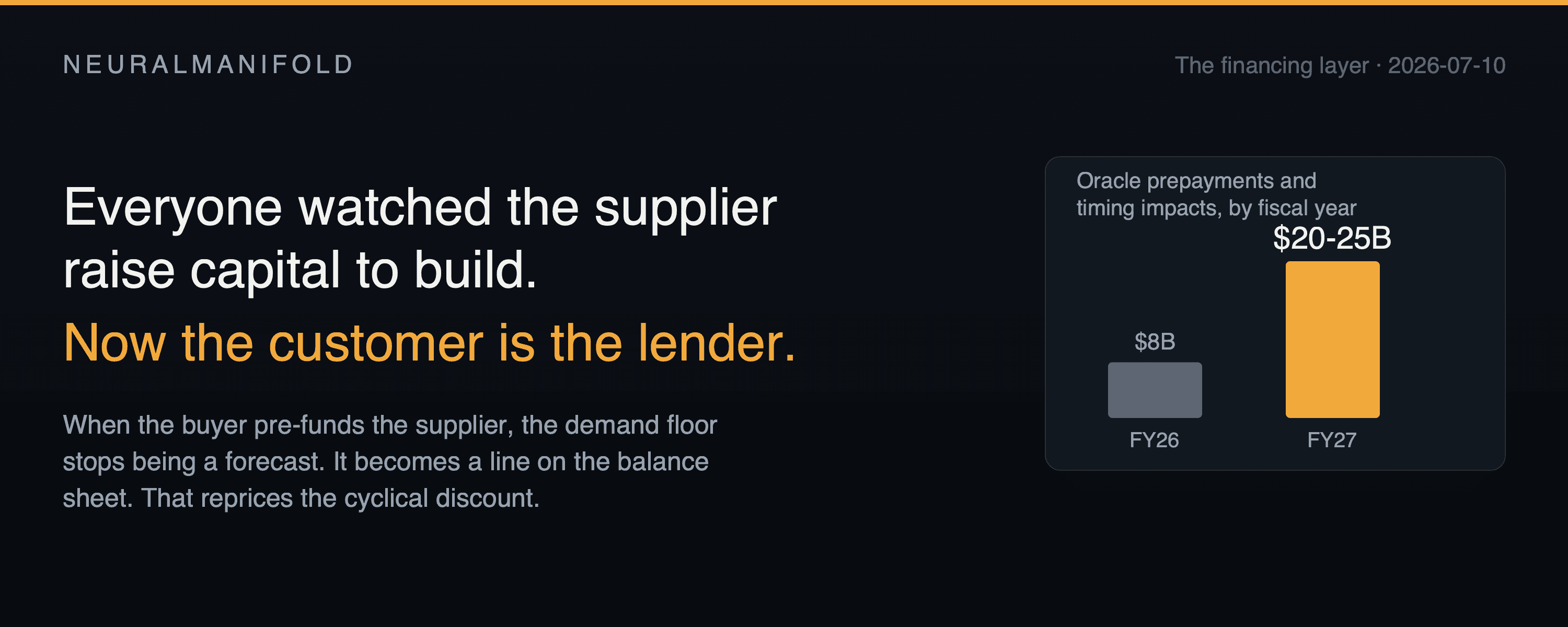
The cleaner tell sits one line lower. Oracle said it signed 67 billion dollars of AI infrastructure contracts in the quarter, the majority either prepaid or bring-your-own-hardware, taking that category to 75 billion dollars. It guided FY27 reported capex to run 20 to 25 billion dollars above its cash outlay because of customer prepayments and timing, against about 8 billion dollars in FY26. Customer-funded capacity has graduated from a footnote into a guidance line. Read it next to Microsoft’s March quarter 10-Q, where investments restricted under a single supplier agreement sit at 11.5 billion dollars, 8.7 billion of it carried as long-term, plus 17.8 billion dollars of receivables tied to facilitating server-component purchases, up from 8.2 billion in June 2025, a 117 percent rise in nine months. Then read Micron’s 10-Q, filed two weeks ago: take-or-pay strategic customer agreements with binding multi-year volumes, and 22 billion dollars of expected deposits and related commitments, about 18 billion of it cash. These are not press-release numbers. They are filed line items that say the buyer has already paid.
The trap in those numbers is that two people read them and reach opposite conclusions, and both are right. The bull reads customer prepayment as a demand floor: the money is in the door, the supplier will get paid. The credit desk reads the same breadth as balance-sheet risk. The same Oracle call that showed 75 billion dollars of prepaid and customer-funded contracts also said Oracle expects to raise about 40 billion dollars of debt and equity in FY27. Across the sector, AI-related investment-grade issuance ran about 152 billion dollars in the first four and a half months of 2026, already more than all of 2025, against Wall Street estimates centered on 300 billion for the full year. The demand floor and the leverage warning are the same capital, counted once as commitment and once as obligation. When Oracle fell 8.5 percent the session after reporting record backlog alongside that funding plan, that was the market pricing the second reading against the first.
Confirmation is not the same as opportunity
Now the discipline, because this is where the thesis meets the tape. Being right that demand credit has moved upstream and being paid for it are different events, and the second one is mostly behind the obvious names.
The suppliers on the receiving end of this credit have already re-rated. Micron, the purest DRAM and HBM expression of the demand being pre-funded, SanDisk on the NAND leg, and Nebius, the neocloud whose entire model is selling contracted backlog, have already run hard. Those are not forecasts of a re-rate. They are a re-rate that already happened, on exactly the names this demand credit lands on. SK Hynix, the purest supply-side expression of the same trade, priced its Nasdaq depositary receipts today at 149 dollars, and they opened at 170.
So the demand-floor insight is real and mostly discounted where it is easiest to see it. The memory and neocloud complex has been pricing this shift for a year. The prepayment structure tells me the demand floor is a balance-sheet fact. It does not tell me the names that sit on it are cheap.
Handicap the binary that is actually open
The obvious debate is whether the demand is real. That is the wrong binary, because the prepayment and the take-or-pay agreement answer it directly. Micron told analysts its strategic customer agreements cannot be canceled: generally five years, annual volume commitments, usually a price band, and a cash deposit on top. A customer that signs that is not forecasting demand. It is committing it. The existence question is closed by the instrument.
The binary that is actually open is whether demand credit moving upstream reduces supplier risk or relocates it. Two mechanisms, opposite signs. In the first, the prepayment and the take-or-pay genuinely strip cyclicality out of the supplier, the FY27 capacity is spoken for, and the historical memory discount compresses toward a utility multiple. In the second, the credit is circular and concentrated. The same handful of hyperscalers and a few private labs stand behind most of it, the labs cannot be seen because they are private, and the leverage funding the prepayments is what the credit market has started to grade. Micron’s own filing lists counterparty default as a risk. A stumble at one large counterparty does not soften demand at the margin. It pulls a pre-committed floor out from under the supplier all at once.
Here is how I handicap it. The demand floor holds and the de-risking is real through FY27, roughly 60 percent, because the contracts are signed, the capacity is sold, and a coordinated buyer retreat is hard when every one of them is short. Financing stress cracks the floor before the demand does, roughly 25 percent, and rising, because the issuance numbers above are the credit market pricing that exact tail. A sharper break from designed-around demand or a genuine capex pause, roughly 15 percent, the tail worth respecting and not trading around. Follow the binary through and the risk in this thesis is not that demand was fake. It is that the demand was financed, and financed demand carries the credit of whoever financed it.
Escalator, not a one-time step
The last question is whether customer-as-lender is a one-time land grab or a structure that deepens each cycle. I read it as an escalator. Oracle’s prepayment and timing line went from about 8 billion dollars in FY26 to a guided 20 to 25 billion dollars for FY27. Microsoft’s server-component receivables rose 117 percent in nine months. Micron has signed 16 strategic agreements since the spring, says demand for HBM is well above its supply in both 2027 and 2028, and is targeting roughly half of company revenue under these contracts. The coverage ratio, the share of a supplier’s forward capacity that is pre-committed before it is built, climbs every generation because each accelerator generation carries more memory content and a richer grade, and the buyers are more afraid of being short than they were the cycle before.
That coverage ratio is the single fact I am watching to govern continuation. If the pre-committed share of 2028 capacity keeps rising while the contracts renew, the demand floor is deepening and the escalator is intact, and the names sitting on it keep running past the first re-rate. If prepayment lines flatten, or new agreements stop getting signed, the floor is thinning even if this quarter’s demand looks fine. The escalator names are the pre-paid memory suppliers whose FY27 and FY28 output is already contractually spoken for. The one-time-story names are the ones renting the demand for a single cycle.
Going a layer down, and being honest about it
The instinct is to find the un-re-rated node under all this. The honest answer is that the receiving end of this credit is picked over, and the genuinely new thing is the structure, not a hidden ticker. Below the big memory names, the layer is tracked and mostly re-rated. Kioxia, the NAND pure-play, trades at roughly 50 times its December 2024 IPO price. The smaller test-handler and specialty-DRAM names wired into the same buildout are tracked too. Each is real, and none screens as a clean un-re-rated pure-play hiding in plain sight.
The one node no public investor can buy is the most telling. A meaningful share of the demand credit in this map traces back to private labs. OpenAI has committed to buy an additional 250 billion dollars of Azure services, and Anthropic 30 billion dollars of Azure compute. Those commitments show up only as backlog and line items on their suppliers’ filings. When the balance sheets doing the committing are uninvestable, that is itself a signal of how much of this demand floor sits outside public markets, and how much of the credit risk in the handicap above you cannot underwrite directly.
The finding
The AI buildout’s demand risk has migrated onto supplier balance sheets as contractual credit. Prepayments, take-or-pay agreements with deposits, and contract-funded debt have turned the demand floor from a forecast into a filed line item, and that structurally mispriced the old cyclical discount on the memory and infrastructure names when the shift began. That is a real link in an awkward place. It is also mostly in the price now, on every name where it is easy to see, which is why this is a finding and not a call.
The edge that remains is a method and a warning, and I will not dress it up as more. The method is to read the instrument. An investment restricted under a supplier agreement, a take-or-pay agreement with a cash deposit, a term loan raised against specific customer contracts, each is the demand floor written down where you can check it, and the coverage ratio into 2028 is the series that tells you whether the floor is deepening or thinning. The warning is that the same capital reads as a floor and as leverage at the same time, and the credit market has started grading the leverage. Financed demand is still demand. It just carries the credit of whoever financed it.
The test is defined, and it is a coverage series, not a headline. The demand floor holds while the pre-committed share of 2027 and 2028 supplier capacity keeps rising and the contracts renew. The read changes when prepayment lines flatten or new agreements stop getting signed at the same time the credit market’s grading, the ratings migration and the widening spreads, starts pricing counterparty risk into the supplier equity. That combination, a thinning floor meeting a credit that has finally been marked, is what would end this. Until then, a customer wiring cash upstream to guarantee supply it cannot yet get is the demand telling me it has years of runway.
None of this is a call. It is what the work found, and what I will watch to know when it changes.
Update, October 2026
The financing half of this essay became the main event. The Fed raised its target range to 3.75 to 4 percent on September 16, Broadcom’s CEO said on October 12 that capital may now be the biggest constraint on AI growth, and on October 21 NVIDIA itself became the lender, announcing capacity reservation advances to suppliers including IBIDEN and KYEC. That sharpened the line this essay ended on: demand financed by a hyperscaler or NVIDIA balance sheet is a different credit from demand financed by a levered neocloud, and that split is now the thing I watch most closely.
Get the next one by email
New essays and signals on the AI build-out and markets, sent when they publish. Free. Unsubscribe any time.
Prefer a feed? RSS.
Keep reading
Research and analysis, not investment advice. Calls are measured from the day they are published. The author may hold positions in companies discussed.