The Constraint Stack, part 2 of 8
The buyer downgrades the spec
The strongest shortage signal is not a price hike. It is a buyer accepting a worse part. Nvidia just did it with glass cloth.
Published from the research archive on . Figures are as of the writing date; the update at the end is current.
Contents
The series has tracked the AI buildout tightening one layer at a time. Memory, then advanced packaging, then optical, then power, and underneath all of them the materials floor of glass cloth, copper foil, and precursors. Tonight is not another layer. It is a way to read how tight a layer already is, from the side of the table almost nobody watches: the buyer’s. The signal that landed this week is the cleanest version of it I have seen, and I am holding it as an emerging read on method, not a verdict on a name.
Here is the claim, stated once. A price hike is the weakest evidence of a shortage, because a buyer paying up has still found the part. The strongest evidence is a buyer accepting a worse part to keep the line moving. That is what Nvidia has reportedly just done with the glass cloth that goes into its AI servers, and it is a harder tightness read than any contract-price headline, because it means the premium input is not available on the needed timeline at any price.
Map the ladder, not just the chain
Most shortage commentary tracks one variable: price. Price is the bottom rung. There is a ladder of buyer behavior above it, and each rung up is a stronger statement that the layer is binding. Read the rung, not the print.
| Rung | What the buyer does | What it means | Live instance |
|---|---|---|---|
| 1 | Pays the spot premium | Tight, but supply exists at a price | Kingboard lifting electronic glass-cloth prices 15% this week, and customers accepting it |
| 2 | Prepays or commits its balance sheet to jump the queue | Price alone no longer secures allocation | Apple saying it is willing to use its balance sheet to help solve the memory shortage |
| 3 | Locks up capacity ahead of need | The buyer is now underwriting the supplier’s output | Market reports that Nvidia’s supply chain has booked Nan Ya’s glass-cloth capacity |
| 4 | Accepts a worse spec to keep shipping | The premium input is unavailable on the timeline at any price | Nvidia accepting a T-glass and standard E-glass mix to speed high-end AI-server shipments |
Rung one is the layer everyone already trades. Rung four is the one that should reset your priors, because a company as engineering-disciplined as Nvidia does not loosen a material spec on the most expensive product it sells unless the alternative is missing the ramp. The ladder is the backbone of this piece. When you can place a buyer’s behavior on it, you have a severity read that does not wait for the price tape to confirm.
This is the buyer-side companion to a discipline I have written about from the supplier side: a layer is only a real chokepoint when the supplier shows it through allocation and blown-out lead times, not because it sits in the bill of materials. The supplier-side test reads tightness from what the seller reports. This one reads it from what the buyer will swallow.
One signal proves the top rung is live
The cleanest telemetry sits in the fiberglass cloth that goes into high-layer-count AI substrates and boards. T-glass and Low-Dk cloth are the high-spec versions the densest accelerators need, and the pure-play that gates them is Nitto Boseki, which TrendForce puts at roughly 90% of global T-glass supply, with no new capacity expected before mid-2027 at the earliest. Taiwan’s substrate makers were already bracing for a 10% to 20% T-glass shortfall in 2026 back in November. The cloth gates IC substrate capacity downstream, which gates advanced packaging.
That is the setup. Here is the rung-four event. Taiwan’s Economic Daily News reported on June 18 that, with T-glass and Low-Dk yields running low, Nvidia has accepted suppliers mixing T-glass with ordinary electronic-grade E-glass cloth to speed high-end AI-server shipments. E-glass is the cheaper, lower-performance cloth. Blending it into a premium accelerator platform to protect the timeline is the buyer telling you, in the only language that cannot be spun, that the good cloth cannot be had fast enough. The same report had Kingboard, the laminate leader, raising electronic glass-cloth prices 15% effective this week with customers accepting the increase, and market talk that Nan Ya’s related capacity has been booked by the Nvidia supply chain and is running full. The substitute is now tightening too. That is what a top-rung shortage looks like as it propagates down a notch.
Translation: the market is still reading glass cloth through price hikes, which is rung one. The actual state is rung four on the premium grade and rungs one and three on the substitute. The layer is tighter than the price headline says.
Confirmation is not opportunity
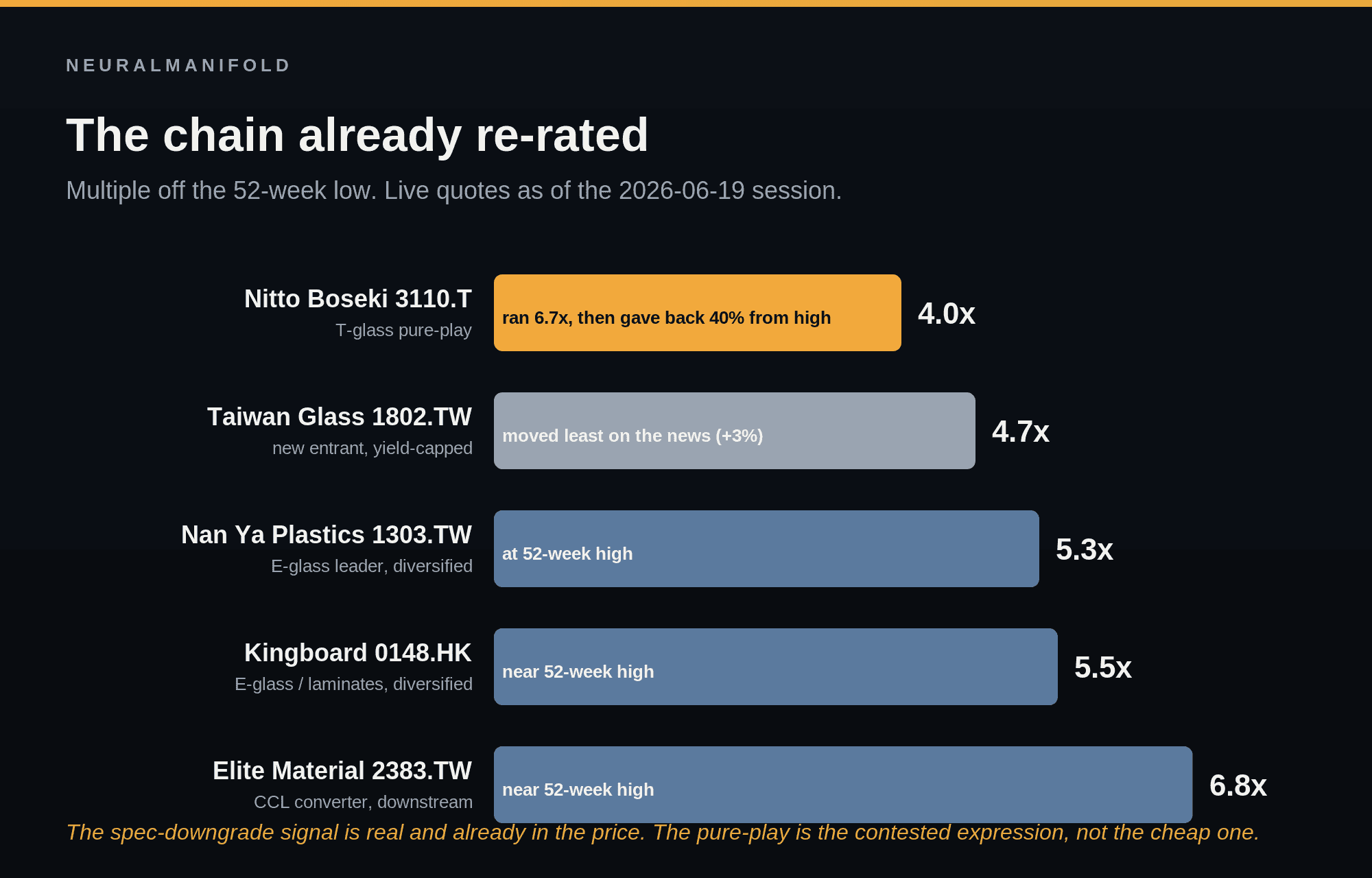
Reading the severity correctly and getting paid for it are different problems, and this is where the read turns uncomfortable. The cloth and laminate chain has already re-rated, hard, and it did most of it before the spec-downgrade signal printed.
Run the quotes as of the June 18 close in Taipei and Hong Kong, both shut today for the Dragon Boat holiday. Nan Ya Plastics closed limit-up at a 52-week high, up more than fivefold from its low and about twice its 200-day average. Kingboard is near its high, up about five and a half times off the low and more than three times its 200-day. Elite Material, the copper-clad laminate converter one step downstream of the cloth, is up nearly sevenfold from its low at a market cap of about NT$2 trillion. The diversified names gained roughly 8% to 10% on the session that carried the report. The signal is real, and it is in the price. A re-rate is the market pricing the start of the shift, and by the time a buyer is publicly loosening a spec, the start is well behind you.
The pure-play tells a more interesting story. Nitto Boseki ran about six and a half times off its low to its high, then gave back roughly 40%, and it fell 9% in Tokyo on the same June 18 session that lifted everything else. It now trades below its 50-day average even as the tightness read on its core product reaches the top of the ladder. The scarcity-priced name de-rated while the scarcity got worse. That divergence is the whole tension of this layer, and it is the thread worth pulling, because it says the market has already started discounting something the spec-downgrade headline does not.
The binary is not the one the screen trades
The obvious binary is duration: does the glass-cloth shortage clear when capacity and yields catch up. Follow it through and it is the wrong question, because it treats the spec downgrade as a supply event. It is a yield event sitting on top of a demand event, and those resolve on different clocks.
So handicap the binary that actually governs the name. Does the premium-cloth tightness persist because demand keeps outrunning capacity, or does it relax because T-glass and Low-Dk yields recover and the buyer re-upgrades the spec. Persist: call it 55%, because Nittobo’s new capacity is not expected before mid-2027, content per AI server keeps rising, and the new entrants are yield-limited. Yields recover and the premium scarcity deflates faster than the demand grows: 30%, and that is the read Nittobo’s 40% pullback is already flirting with, because the one thing that breaks a yield-driven premium is the yield problem getting solved. The tail, that the buyer designs the high-spec cloth out by re-architecting the substrate: 15%, slow but real over a couple of generations. The weight is on persistence, but the live de-rate in the cleanest pure-play says the market is paying up for the 30% case, which is exactly why chasing the cloth names here is not the same trade as recognizing the shortage.
Escalator on the cloth, dilution in the names
A re-rate is not a disqualifier. The test is whether the underlying driver is a one-time step or a structural escalator. Glass-cloth content is an escalator: each accelerator generation adds substrate layers and pushes to higher-spec, lower-loss cloth, so the premium grade pulls a larger share of every server built. That is the durable part, and it is why the layer keeps mattering after the first re-rate.
The problem is the expression. The cleanest escalator exposure is the pure-play, Nittobo, and that is the name the market just de-rated 40% off its high on the yield-recovery worry. The names still pinned at their highs are the diversified converters, Nan Ya, Kingboard, Elite Material, where the AI cloth is real but diluted inside plastics, laminates, and legacy electronics revenue. So the escalator is genuine and the clean way to own it is the contested one. The single fact that governs which way this breaks is the T-glass and Low-Dk yield rate. When yields recover, the spec re-upgrades, the substitute story fades, and the pure-play scarcity premium keeps deflating. While yields stay broken, the buyer keeps mixing grades and locking up capacity, and the gap holds. That number, not the next price-hike notice, is the one to watch.
Going further, the chain is picked over
The honest next move is to go below the cloth, into the glass yarn and the new entrants the consensus screen does not surface, and report what is actually there. What is there is a chain that has already run. Taiwan Glass, the new entrant whose capacity would relieve the gap, is up more than fourfold from its low but moved the least of the group on the news, roughly 3% against 8% to 10% moves elsewhere. That muted move is itself a signal: the market does not yet believe the new entrant’s yields are good enough to break Nittobo’s share, which is the same yield problem that forced the spec downgrade, read back from the equity. The new supply is not trusted, and the price says so.
There is no clean, un-re-rated public node left in this layer. The pure-play already ran six and a half times and then de-rated on the yield worry. The diversified names sit at highs with the AI cloth diluted. The new entrant is up fourfold and distrusted. I am not going to manufacture a winner where the price already left, and I am not naming one tonight, because the only pure-play chokepoint here is Nittobo and every other node is either diversified or yield-capped. When the chain is this thoroughly picked over, saying so is the finding.
What the work found
The finding is a method, not a ticker. The severity ladder is a repeatable, buyer-side way to grade a shortage: pay the premium, prepay the queue, lock up the capacity, accept the worse part, in rising order of how binding the layer is. The spec-downgrade rung is the most extreme reading on it, and it just fired on premium glass cloth, the same week the diversified cloth and laminate names printed at or near 52-week highs. The two facts together are the whole lesson. The signal told you the layer was at the top of the ladder, and the tape told you the layer was already owned by everyone who reads a price. The edge was never going to be buying the cloth names after a fivefold move. The edge is using the ladder to know how tight a layer is before the price confirms it, and then checking whether the same tightness is already expressed somewhere else in the stack. Here it runs up through advanced packaging and memory, where the same buyers are paying premiums and prepaying for allocation. The one genuinely live question the work leaves open is the pure-play divergence: Nittobo de-rating while its product tightens is the market handicapping a yield recovery, and that handicap, not the shortage, is the thing left to be right or wrong about. The fact to watch is T-glass and Low-Dk yields recovering far enough that the buyer re-upgrades the spec and stops locking up capacity. That would be the rung-four signal going into reverse, and the first hard evidence that the premium-cloth scarcity is clearing.
Update, October 2026
The shortage held and the pure-play kept falling, which is the divergence this piece flagged: Nittobo said in August that even tripling its capacity by March 2029 will not be enough, yet its stock is down about 28% from the June 19 close. The financing rungs of the ladder fired higher up the chain: on October 21 Nvidia announced capacity reservation advances to substrate and test suppliers including IBIDEN, Unimicron, and KYEC, and Micron’s fiscal Q3 filing disclosed about $22 billion of customer deposits and commitments under its strategic customer agreements.
Get the next one by email
New essays and signals on the AI build-out and markets, sent when they publish. Free. Unsubscribe any time.
Prefer a feed? RSS.
Keep reading
Research and analysis, not investment advice. Calls are measured from the day they are published. The author may hold positions in companies discussed.