Anthropic's S-1 adds up to about $855 billion of compute. Not all of it is firm.
The notes add up to about $855 billion of compute commitments. The firm money goes to hyperscalers and TPUs; the Nvidia neocloud deals hinge on power.
GOOGL AMZN AVGO NVDA MSFT AMD
Anthropic filed its S-1 this morning. Most coverage will lead with the headline loss. I read it for something else: the most detailed public map yet of what one frontier lab has promised to spend on compute, who it promised it to, and how binding each promise is.
The summary leaves the headline commitment total blank for now, but the notes to the financial statements let you add it up:
| Component | Amount | Where in the S-1 |
|---|---|---|
| Fixed minimum purchase commitments, June 30 | about $265.6B | Note 13 |
| Leases already running, June 30 (undiscounted) | $2.1B | Note 7 |
| Leases signed but not yet started, June 30 | $321.4B | Note 7 |
| New and amended agreements after June 30 | about $245B | Note 17 |
| Short-term commitments after June 30 | about $21B | Note 17 |
| Total | about $855B |
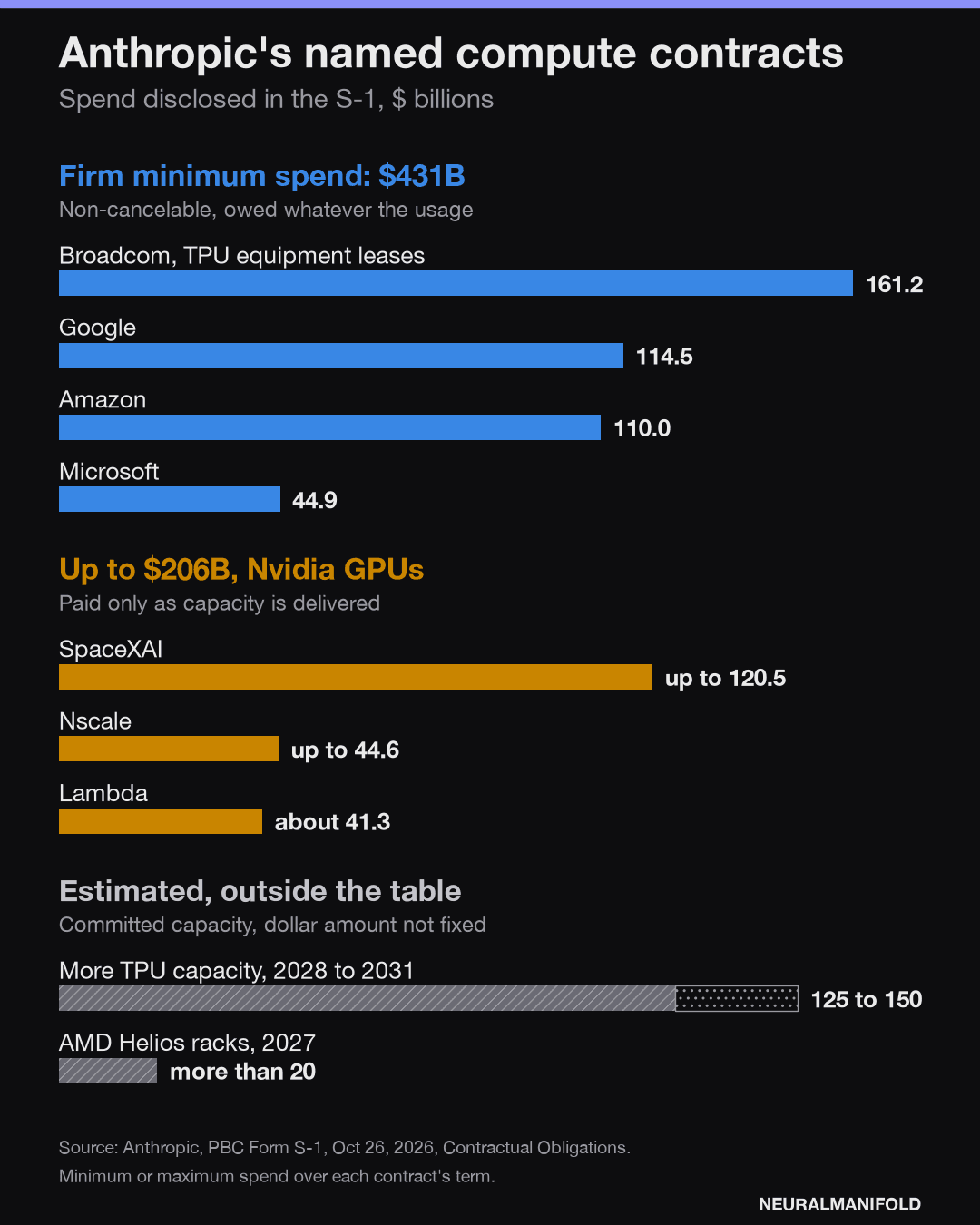
That is before the agreements with no fixed dollar amount, which the filing estimates at $125 billion to $150 billion for more TPU capacity and more than $20 billion for AMD. Some of the post-June amounts depend on contract conditions being met, so treat $855 billion as an order of magnitude, not an audited figure. Seven counterparties are named with amounts, worth $637 billion between them, though the filing does not say exactly how each one maps into the total. Most of it is new. At the end of 2025 the same two notes held $54.6 billion of purchase commitments and $50.2 billion of unstarted leases; six months later they held $265.6 billion and $321.4 billion. The useful part is not the total. It is how unevenly firm it is.
Why commit this much: the scaling-law bet
The filing states its reason plainly. Anthropic says model performance has improved predictably as model size, training data, and compute grow, the relationship its founders helped document in the original scaling-laws paper, and it expects demand for AI to outrun supply for years, “limited principally by the availability of compute.” Read that way, the commitments are not a spending spree. They are the scaling curve written into contracts: if each step up in compute keeps buying a better model, locking in capacity years ahead is the cheap move, not the reckless one.
The risk factors carry the other side. The same filing warns that those relationships may plateau or fail to hold at larger scales, and take-or-pay contracts do not care which way it goes. If the curve bends, the firm spend is still owed. That makes this S-1 the clearest public statement yet of the bet the whole build-out rests on: compute demand keeps compounding because capability keeps compounding.
The firm money goes to hyperscalers and TPUs
About $431 billion is minimum spend that Anthropic owes whether or not it uses the capacity: $161.2 billion of rent on Broadcom TPU equipment leases, $114.5 billion to Google, $110.0 billion to Amazon, and $44.9 billion to Microsoft. On top of that, it expects to pay $125 billion to $150 billion for more TPU capacity delivered between 2028 and 2031. TPUs are the single largest bet in the filing, and every one of those chips needs HBM. That is more contracted demand for the memory layer, which is already sold out.
The Nvidia neocloud money is conditional
The Nvidia GPU capacity sits mostly with neoclouds, and those contracts read differently. SpaceXAI is up to $120.5 billion, about $3.1 billion a month once all capacity is delivered, but either side can cancel on 90 days’ notice after initial periods that end in early 2027. Nscale is up to $44.6 billion, paid only as capacity is delivered, and Nscale still has to use best efforts to line up financing for the GPUs and the data centers. Lambda is about $41.3 billion, and $34.9 billion of it can be terminated if Lambda does not secure the facility lease in time.
That is $206 billion where the money moves only if someone finds the power, the shell, and the financing. The risk factors say as much, naming scrutiny over “the allocation of limited power resources” in regions where Anthropic has contracted compute.
What the money buys, in gigawatts
The S-1 never mentions a gigawatt. The counterparties do. Broadcom told investors Anthropic will take about 3.5 gigawatts of TPU capacity through it from 2027, on top of the more than 1 gigawatt Google said would come online in 2026. Amazon says its deal covers up to 5 gigawatts, with nearly 1 gigawatt running by the end of this year. Microsoft and Nvidia said up to 1 gigawatt, and AMD up to 2 gigawatts starting in 2027. Press reports put Nscale at about 460 megawatts and Lambda at about 350.
The Broadcom numbers line up with the filing almost exactly. The 2026 lease is $125.2 billion of rent, which over 3.5 gigawatts is $35.8 billion a gigawatt. The rest of the $161.2 billion, about $36.0 billion, matches the roughly 1 gigawatt of TPUs Broadcom shipped Anthropic for 2026 at the same price. Two leases, one price per gigawatt: the 2026 lease is the 3.5 gigawatts. That match is my inference, not a figure in either filing, and it covers the equipment only. The buildings and the power are paid for separately.
SpaceXAI is the one large contract with no capacity figure. Its first deal, in SpaceX’s own filing, priced about 325,000 GPUs at $1.25 billion a month, or about $5.27 per GPU-hour. At that rate $3.1 billion a month buys roughly 800,000 GPUs, which is 1.2 to 2.0 gigawatts.
Add it up and Anthropic has contracted about 4.5 gigawatts online by the end of 2026, about 10 by the end of 2027 and about 15 by the end of 2028. My build-out model puts all the AI capacity running outside China at about 71 gigawatts by the end of 2027. One lab holds roughly one gigawatt in seven of it, somewhere between 8% and 20% once the uncertainty in both figures is counted.
Memory is still the tightest constraint on all of this; my ranking of the layers puts it first today and power first two to three years out. The model gives power a 44% chance of being the tighter of the two by the end of 2027. If it is, the first contracts to feel it are the conditional ones above: the deals that wait on someone else finding a site, a lease and the money.
The financials, and what the $80.7 billion loss really is
Here is the summary income statement as filed, in millions of dollars. Losses are in parentheses.
| 2023 | 2024 | 2025 | H1 2025 | H1 2026 | |
|---|---|---|---|---|---|
| Revenue | 41 | 386 | 4,585 | 1,163 | 16,286 |
| Compute and infrastructure | 433 | 2,522 | 7,326 | 2,334 | 8,945 |
| Personnel | 95 | 454 | 1,839 | 538 | 3,152 |
| Sales, marketing, and partnerships | 2 | 43 | 568 | 120 | 3,168 |
| Other operating and administrative | 62 | 347 | 1,412 | 306 | 1,714 |
| Copyright settlement (Bartz) | 0 | 0 | 1,500 | 0 | 0 |
| Operating loss | (551) | (2,980) | (8,060) | (2,135) | (693) |
| Interest income | 69 | 106 | 431 | 115 | 1,111 |
| Change in fair value of convertible notes, derivatives, and SAFEs | (1,045) | (5,434) | (34,308) | (10,942) | (72,388) |
| Other income (expense), net | (2) | 0 | (8) | 0 | (8,757) |
| Income taxes | (2) | (1) | (20) | (7) | (21) |
| Net loss | (1,531) | (8,309) | (41,965) | (12,969) | (80,748) |
The top half is the business, and it turned. Revenue went from $1.2 billion in the first half of 2025 to $16.3 billion a year later. Compute and infrastructure fell from 160% of revenue in 2025 to 55%, and the operating loss shrank to $693 million on fourteen times the revenue.
The bottom half is where the $80.7 billion comes from, and it is an accounting feature, not a cash loss. Anthropic carries its convertible notes at fair value, and the main one still outstanding is about $6.2 billion of non-interest-bearing notes held by Amazon that convert into shares at the IPO. A note that turns into stock is worth more when the company is worth more. So every time Anthropic’s valuation rose, the notes were marked up, the liability on the balance sheet grew, and the increase was charged to the income statement as a loss: $72.4 billion in the half. Most of the other $8.8 billion is the same effect from the other side. In March and April, Anthropic agreed to sell preferred stock to Google and Amazon at a fixed $259.14 a share; as its value rose, a promise to sell at that fixed price became a cost, and it is marked to market each period.
No cash left the company for any of it. It is the bill for becoming more valuable, booked against a liability that turns into equity when the shares list, which is why the filing’s pro forma figures add it back. Take out the two marks and the first half was roughly breakeven or better: the $693 million operating loss was more than covered by $1.1 billion of interest income on Anthropic’s cash, which works out to about $0.4 billion of profit. That last figure is my arithmetic, not one Anthropic reports, and the other-expense line also holds smaller items like lease interest, so treat it as approximate.
What I am watching
The amendment that fills in the blank totals, which will show how close this reconstruction is, and sets a price range. Whether Nscale lands its financing and Lambda its lease, because that is where Anthropic’s Nvidia capacity is least certain. Whether either side walks away from SpaceXAI once its cancellation window opens in early 2027. And whether the TPU estimate for 2028 to 2031 hardens into a firm commitment with a gigawatt figure attached.
Get the next one by email
New essays and signals on the AI build-out and markets, sent when they publish. Free. Unsubscribe any time.
Prefer a feed? RSS.
Research and analysis, not investment advice. Calls are measured from the day they are published. The author may hold positions in companies discussed.