The shortage signed a contract
Take-or-pay contracts are turning memory from a cycle into a utility with growth. The market re-rated the price, not the durability.
Published from the research archive on . Figures are as of the writing date; the update at the end is current.
Contents
Memory was the first layer of the AI build-out to go tight, and for two years the trade was the shortage itself. That trade is mostly priced now. Dan Ives called memory “the golden child” of the AI build-out this week and put demand at 15 times supply, which is another way of saying the shortage is consensus. When the bottleneck is the headline, the easy multiple expansion is gone.
So here is the read I am carrying into the back half of the year, held as an emerging read, not a verdict: the memory layer is doing something more interesting than staying tight. It is changing what kind of business it is. In three weeks the same structure surfaced at three DRAM makers. Micron disclosed signed take-or-pay contracts, Nanya printed the pricing power they produce, and analysts covering SK hynix now estimate that about half its revenue runs through long-term agreements. The effect is not a bigger cycle. It is the end of the cycle as the market has always priced it. The shortage signed a contract. Memory is being re-rated from a cyclical commodity into a utility with growth, and almost nobody is pricing that as the trade.
The map is a table of contracts, not a supply chain
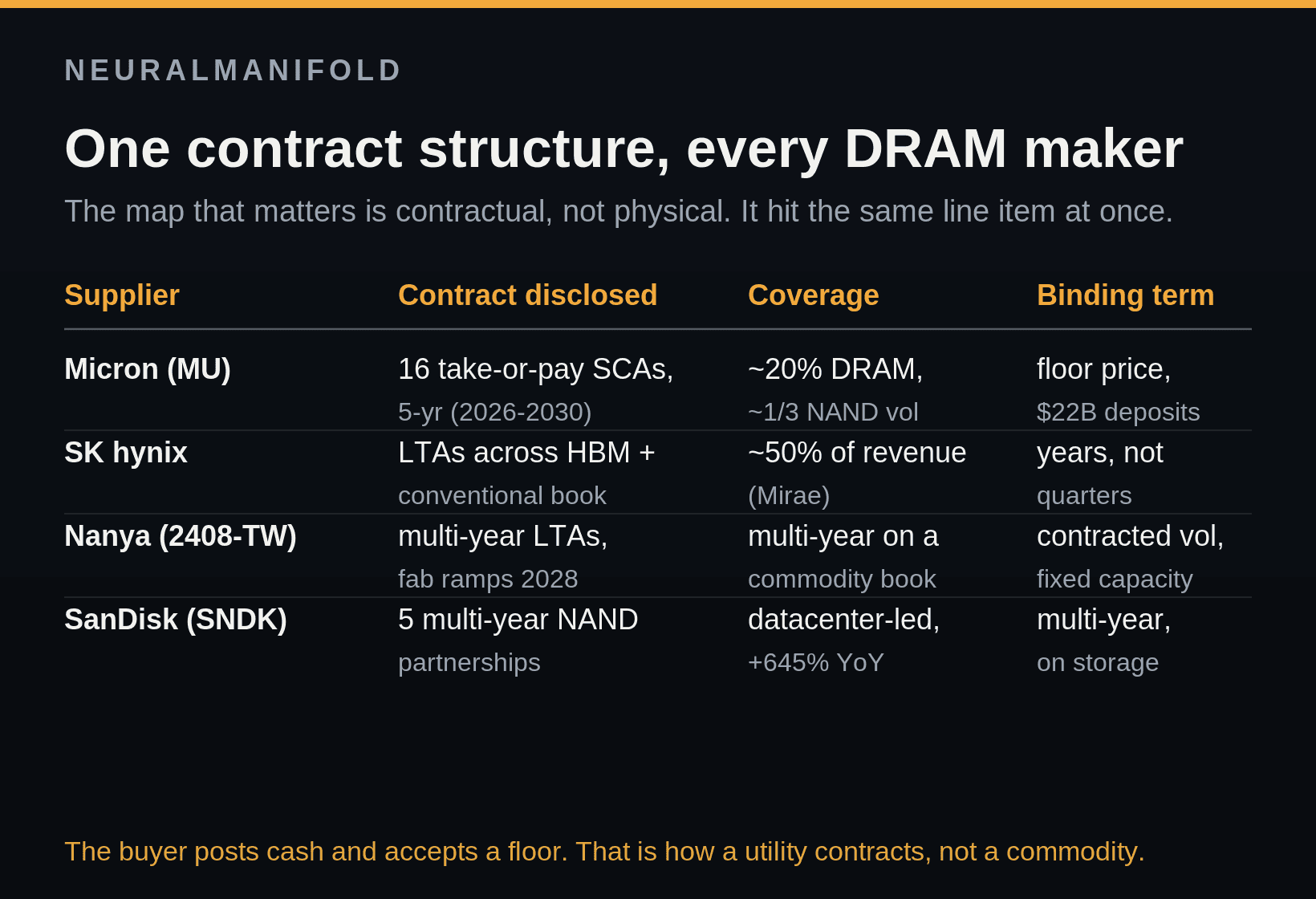
The usual constraint-stack map traces silicon from input to chokepoint to buyer. This one is different. The structure that matters is not physical, it is contractual, and it is showing up on the same line item across the memory makers at once.
| Supplier | Contract structure | Coverage | The binding term |
|---|---|---|---|
| Micron (MU) | 16 take-or-pay strategic customer agreements, mostly 5-year terms (2026 to 2030) | ~20% of DRAM volume, ~1/3 of NAND volume; ~$100B of revenue at minimum price | Floor price through the term; $22B of customer deposits and commitments behind it |
| SK hynix | Long-term agreements across the HBM and conventional book | ~50% of revenue under LTAs (Mirae Asset estimate) | Volume and price smoothed across years, not quarters |
| Nanya (2408-TW) | Three-year supply agreements signed in April with Solidigm, Kioxia, Cisco and SanDisk | Multi-year coverage on a commodity-DRAM book | Contracted volume while capacity stays fixed until the new fab |
| SanDisk (SNDK) | 5 signed multi-year “new business model” agreements (NAND) | Datacenter the fastest-growing line, up 645% year over year | Multi-year commitments on the storage layer |
Read Micron’s version closely, because it is the most disclosed. In its June 24 prepared remarks, Micron announced 16 signed agreements, take-or-pay, with binding volume commitments over a typical five-year term. Fourteen of them carry roughly $100 billion of cumulative revenue at the minimum contract price. Behind the contracts Micron projects $22 billion of customer deposits and financial commitments, about $18 billion of it in cash. The largest agreements carry a ceiling at the current market price and a floor that holds through the term, and Micron says the floor alone supports gross margins “well above our peak quarterly margins in any past cycle.” When every planned agreement executes, Micron expects roughly 40 percent of revenue to be fixed-price or capped near current prices.
Translation: the buyer is now committing cash up front to lock supply it cannot afford to be without, and it is accepting a floor price to do it. That is not how a commodity trades. That is how a utility contracts.
One number proves it is structure, not narrative
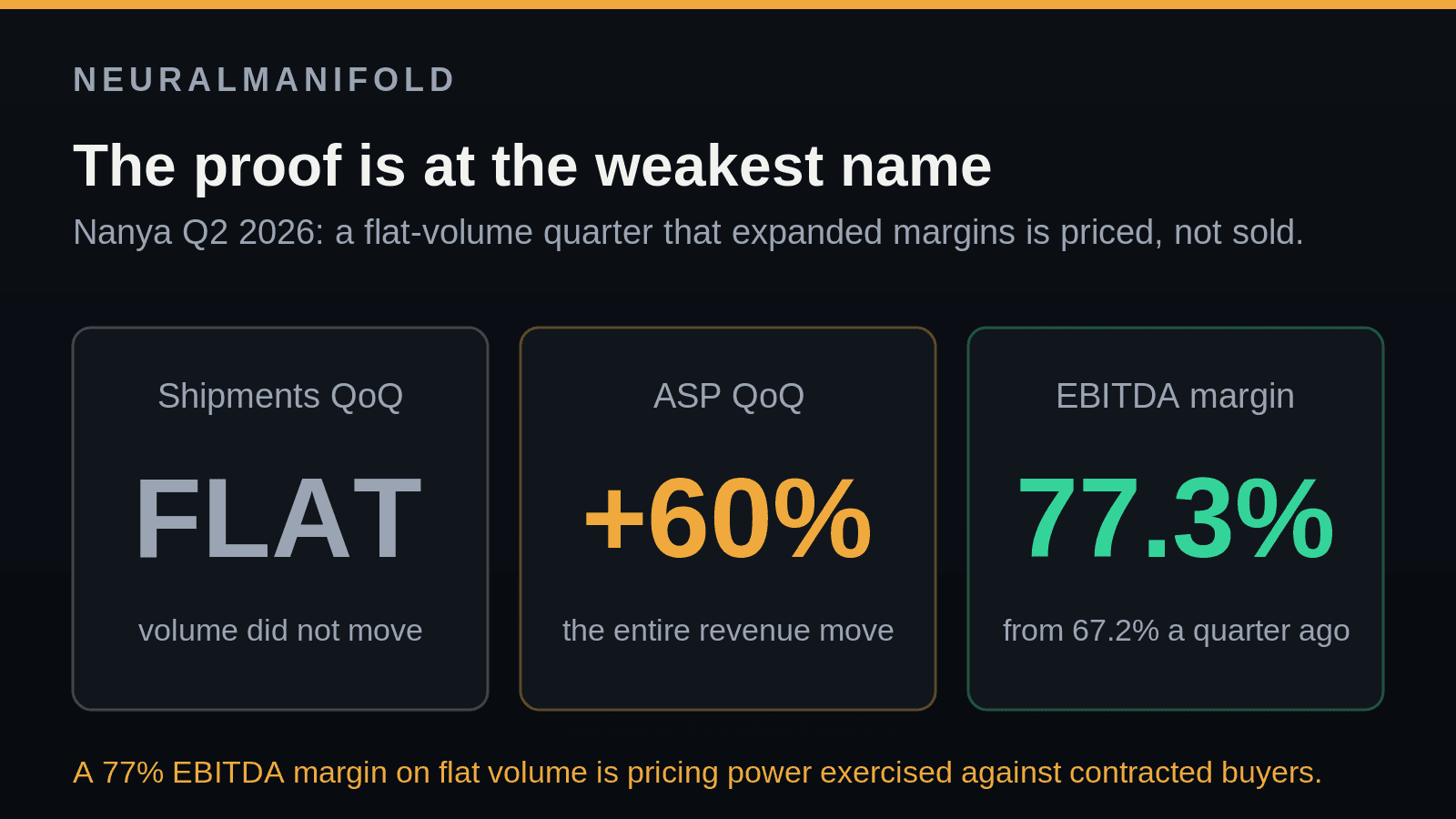
Every thesis this clean attracts the same rebuttal: it is a cycle dressed up, and the disclosures are just the top of the cycle talking. There is a single number that answers that, and it does not come from Micron. It comes from Nanya.
Nanya is the least advantaged DRAM maker on the map. No HBM leadership, a commodity book, a new fab that does not add meaningful volume until 2028. In its June quarter, bit shipments were broadly flat. Volume did not move. Revenue still rose 68 percent sequentially, because average selling prices rose more than 60 percent, and the EBITDA margin went to 77.3 percent from 67.2 percent. A commodity DRAM maker with flat volume printed a 77 percent EBITDA margin and a 79.5 percent gross margin.
That is the tell. A flat-volume quarter that expands margins that far is not a demand surge, it is pricing power. And it showed up at the weakest name on the board, the place you would least expect a 77 percent margin if this were only the top of a cycle. The structure is real because the least-advantaged player is printing it too.
Confirmation is not opportunity, so where is it priced
Being right about the structure is not the same as being paid for it. So I want to be honest about what the market has already done here.
The re-rate has been violent at the top. Micron roughly tripled between January 1 and this week, adding more than $600 billion of market value in about six and a half months. Micron trades where it trades because a lot of this is understood. I am not pretending there is a cheap entry on the tape.
And yet the forward multiple says the re-rate is incomplete, which is the tension worth holding. On Korean sell-side 2027 estimates, SK hynix and Samsung trade at roughly 3.5 to 4 times forward earnings. Those are cyclical-trough multiples sitting on top of a contracted-earnings structure. The market has re-rated the market cap on the shortage and has not re-rated the multiple on the durability. If the earnings stream is genuinely becoming utility-stable, a 3.5 times forward multiple is pricing a cycle that the contracts are designed to remove. Either the contracts are not believed, or the durability is not priced. That gap is the whole argument.
The binary everyone is watching is the wrong one
The consensus debate is whether the memory cycle is about to roll over. The bears have real datapoints. Selling-price growth moderates as contracts smooth it. Korea Investment & Securities cut its June-quarter estimate for SK hynix to roughly 7 to 8 percent below consensus, explicitly to reflect LTA pricing. Memory is now close to 60 percent of the bill of materials on a sub-$400 phone, per Omdia, which destroys some low-end volume. And the tape agrees with the bears right now: the Philadelphia semiconductor index fell about 8 percent in the week to July 16, and the memory names led it down.
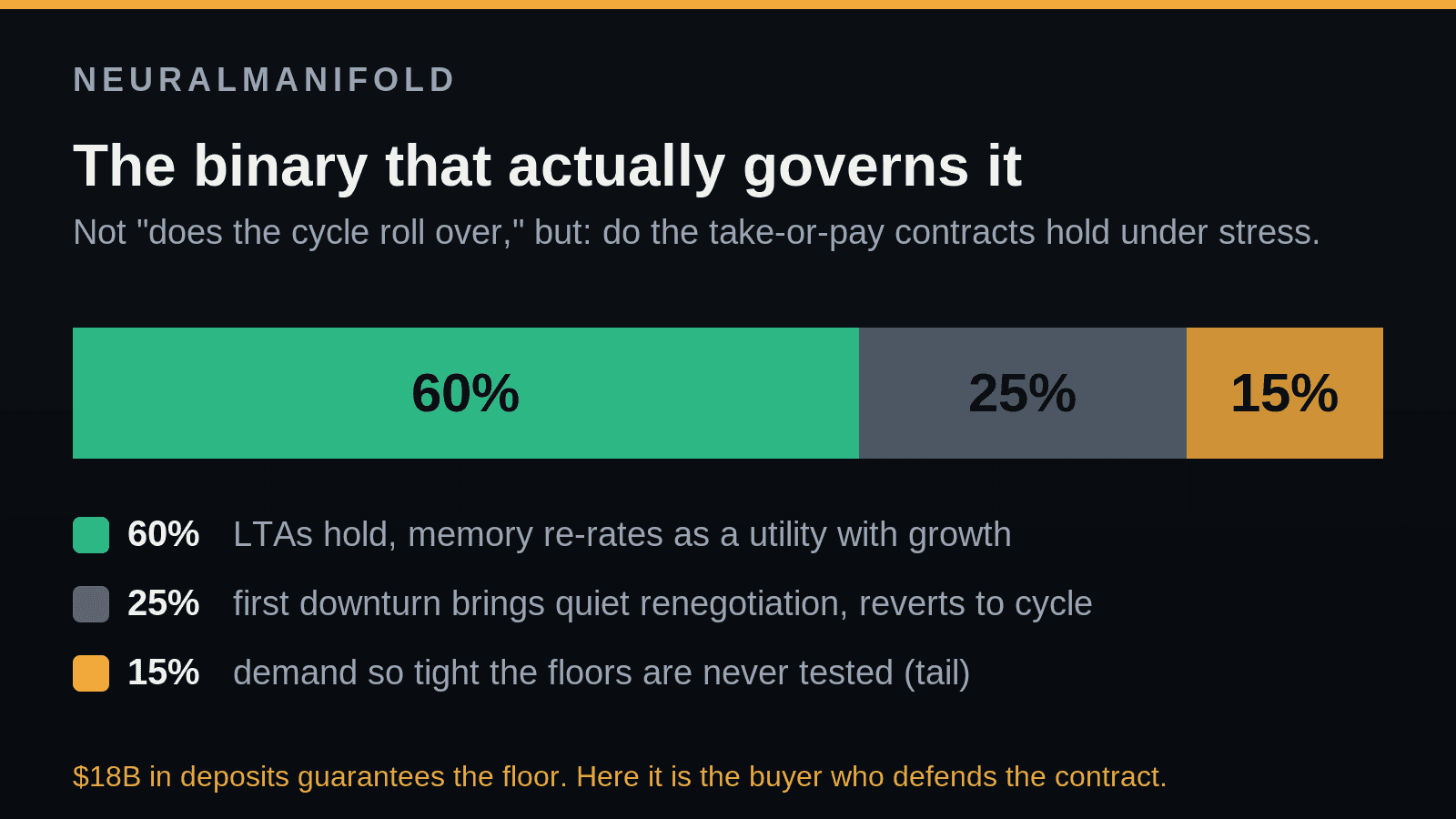
Follow the structure through, though, and the roll-over question is the wrong binary. The take-or-pay contracts are built precisely to make a demand air pocket not matter to the supplier’s floor. So the binary that actually governs the thesis is narrower and almost nobody is stating it: do the contracts hold when a buyer goes underwater on one.
Here is how I handicap it. Roughly 60 percent that the LTAs hold and memory re-rates as a utility with growth, because the contracts are take-or-pay with billions in deposits committed, and it is the buyers who asked for them to internalize supply risk. When the customer is the party defending the contract, the contract is durable. Roughly 25 percent that the first genuine downturn brings quiet renegotiation, a deposit clawback here, a volume waiver there, and memory reverts to trading like the cycle it always was. And roughly 15 percent to the tail where demand stays so far ahead of supply that the floors never get tested at all, which is what Meritz Securities is implying when it models DRAM fulfillment at only 75 to 80 percent of demand in the second half of 2026 and around 60 percent in 2027. In that world the contract is irrelevant because the spot market never falls to the floor.
The reason the structure tilts toward hold is the direction the cash flows. In a normal cycle the supplier defends price and the buyer walks when spot drops. Here Micron’s buyers have committed about $18 billion in cash deposits to secure supply under a floor. The party with the incentive to honor the contract is the one who can most afford to, and who is most afraid of being without the part.
Step or escalator
A re-rate is not automatically a durable trade. Some are one-time steps that stall, and some are escalators that keep climbing. The question for memory-as-utility is whether the contracted share is a fixed level or a ratchet.
I think it ratchets, and the evidence is in the coverage numbers. Each GPU generation carries more memory than the last: Vera Rubin over Blackwell, and Rubin Ultra targeting a terabyte of HBM per GPU package. The HBM trade ratio pulls capacity away from conventional supply, tightening the whole book. As that happens the buyers extend coverage rather than shrink it. Micron already expects the fixed-or-capped share to reach about 40 percent of revenue as its planned agreements execute, and roughly half or more of revenue to sit under the agreements once they are complete. That is the escalator. The re-rate that has runway is the one where the earnings-volatility discount keeps compressing, cycle after cycle, because coverage keeps rising.
The single fact I am watching to know which it is: the contracted-revenue percentage. If Micron’s fixed-or-capped share climbs past 40 percent next year and the Koreans disclose rising coverage, the utility thesis compounds and the forward multiple has to follow. If coverage stalls near current levels, this was a one-time step and the old cyclical discount comes back.
Going a layer down, into the name nobody re-rated
The consensus screen for this theme returns Micron, SK hynix, Samsung, and SanDisk. Three of those are heavily re-rated and one is Samsung. So where is the structure sitting inside a multiple that has not moved for it?
Nanya is the honest answer, and I want to give it with the caveats attached rather than dressed up. It is the same contracted structure I mapped above, printing a 77 percent EBITDA margin on flat volume, and it is the one node on the board where that structure is not in the equity story yet, because the market still files Nanya under commodity-DRAM value trap. The caveats are real. It is Taiwan-listed, so access carries foreign-market friction. The margin is a cyclical peak by construction, and a commodity DRAM maker has burned this kind of margin before. LTA disclosure is thinner than Micron’s, so the durability I am crediting is partly inferred. This is a name to understand, not a name I am calling. It is on my watch list, nothing more.
The contrast that sharpens it is Kioxia, the NAND pure-play, whose share price has roughly halved from its June peak in the same rotation. Kioxia is only now moving toward long-term agreements (it is targeting about half of volume under them by 2028), and it is trading like the cycle because that is still mostly what it is. The gap between Kioxia trading like a cycle and SanDisk contracting like a utility is the entire thesis expressed as two NAND names.
And the loudest signal comes from the supplier that was supposed to break the shortage. CXMT, the Chinese entrant that was supposed to be the supply flood and is still private on the eve of its Shanghai listing, is reportedly booked through the end of 2027, with PC makers paying above historical prices to secure it. The bear case for memory is itself sold out about eighteen months forward. When even the designed-around supplier is allocated out past the horizon, that is not a market with slack. That is how tight looks from the one seat with an incentive to deny it.
The finding
The finding is that the memory trade has quietly changed shape. The edge is no longer the shortage, which is consensus and priced. The edge is a structural re-rating in progress: take-or-pay contracts are contracting away the earnings volatility that earned memory its permanent discount, and the forward multiple has not followed the market cap in crediting it. The one question that governs the whole thing is not whether the cycle rolls over. It is whether the contracts hold through the first buyer who goes underwater. That is a narrower, more answerable question than the one the market is arguing about, and it is why I think the layer still holds an unpriced question after the shortage stopped being a secret.
What would change the read: a confirmed HBM4 yield breakthrough at SK hynix or Samsung that demonstrably erodes Micron’s pricing power, or a hyperscaler signal that 2027 capex is rotating away from memory-intensive architectures. To those I add one utility-specific trigger, the one this essay turns on: any disclosure of a take-or-pay agreement being renegotiated, waived, or breached. That is the datapoint that would tell me the contract was optics and the cycle never left. Until it prints, I read the structure as intact.
This is not a recommendation and it does not name an entry. It is a claim about where the real uncertainty lives, which is the only thing worth publishing once the obvious trade is gone.
Update, October 2026
The contract structure kept building after this was written: on September 30 Micron reported 26 signed agreements, about $32 billion of customer commitments, roughly $150 billion of remaining performance obligations, contracts now running into 2031, and supply-demand conditions it expects to be much tighter in fiscal 2027 and 2028 than in 2026. On the call, chief operating officer Manish Bhatia said more than 75% of Micron’s shipments for fiscal 2027 were already committed (transcript). The specific test I set is not settled, though: Micron now sizes the signed agreements at over 35 percent of revenue through 2030, with three quarters of that on a defined pricing framework, which is not the same measure as the 40 percent fixed-or-capped share I said I was watching. The contracted share is rising, so the escalator reading is ahead of the step reading, but the test stays open until Micron reports on the measure I named.
Get the next one by email
New essays and signals on the AI build-out and markets, sent when they publish. Free. Unsubscribe any time.
Prefer a feed? RSS.
Keep reading
Research and analysis, not investment advice. Calls are measured from the day they are published. The author may hold positions in companies discussed.